

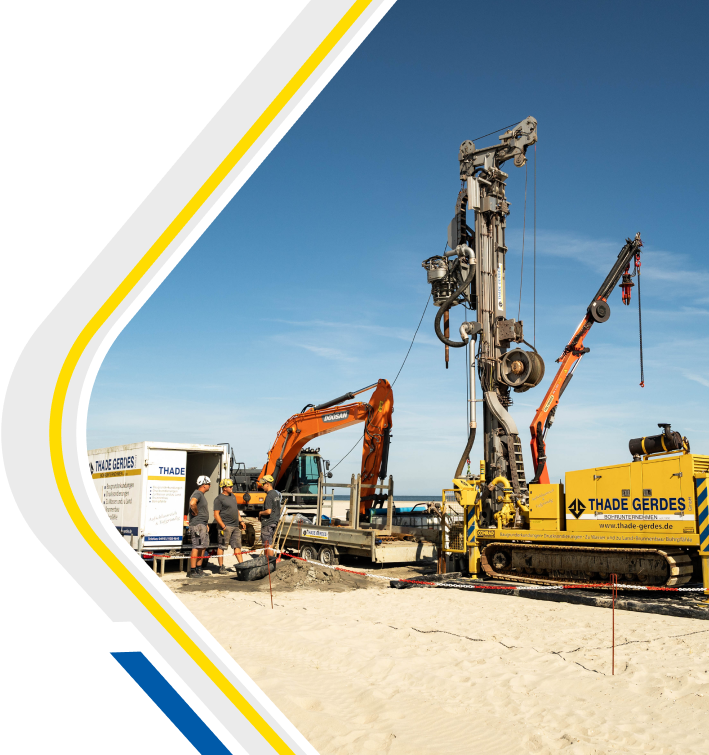

Imagine you’ve found the perfect building lot—but then the crucial question arises: what’s the right foundation? As the building’s lowest load-bearing structure, the foundation ensures that your building stands stable and secure on the ground. It is responsible for distributing the load evenly. However, if construction takes place on unstable or soft ground, there is a risk that the building will sink or tilt, causing damage to the building’s structure.
In the worst-case scenario, choosing the wrong type of foundation can cause gas lines to become misaligned—and that can even be life-threatening. That’s why it’s of the utmost importance that you choose the right foundation. In this article, we’ll explain the differences between shallow foundations and deep foundations. We’ll show you which method is best suited for your construction project.
Here’s a quick overview of the key differences between shallow foundations and deep foundations:
Shallow foundation is a quick and cost-effective method in which the foundation rests on stable soil. However, it is not suitable for soft soil or heavy buildings. Deep foundations are used when the topsoil is not stable enough to support the structure, such as in the case of soft soil. They provide a stable foundation even for large and heavy structures. The choice of foundation depends on the soil conditions and the type of structure being planned. |
Table of Contents
What is a shallow foundation?
Shallow foundations are a widely used foundation method in which the foundation rests directly on the topsoil. This method is frequently used for structures built on stable and load-bearing soil. Shallow foundations can be used for light to medium-weight buildings, such as single-family homes or smaller office buildings.
Characteristics of Shallow Foundations
🏗️ Placement in near-surface soil:
The foundation is constructed directly on a load-bearing layer of soil near the surface. It is often designed as strip foundations (linear foundations under load-bearing walls, cast in concrete) or slab foundations (a continuous concrete slab covering the entire building). These methods are suitable only for extremely stable and load-bearing soils.
🏗️ Simple Construction:
Shallow foundations are generally simple structures and therefore require little planning. No specialized techniques or deep drilling are required.
🏗️ Reduced material requirements:
Due to their flat structure, shallow foundations require little material. Generally, only concrete, reinforcing steel, and, if necessary, gravel or sand as fill material are needed.
Advantages of Shallow Foundations
✅ Cost savings:
Shallow foundations require less labor and are technically easier to install. This makes them a cost-effective option for simple construction projects.
✅ Fast construction time:
Since no major earthwork is required, shallow foundations can be installed more quickly. This results in a shorter construction period and an earlier completion date.
Disadvantages of Shallow Foundations
❌ Not suitable for unstable or soft ground:
If the ground does not provide sufficient bearing capacity—for example, in marshlands, coastal regions, or river areas—settlement may occur. Due to the load applied by the structure, the soft soil is compressed, resulting in damage to the structure. If gas lines are affected, there is a risk to life.
❌ Not suitable for heavy structures:
Shallow foundations are insufficient for heavy or tall structures because they distribute the building’s load only to the soil layers near the surface. Here, too, the bearing capacity is compromised, so stability cannot be guaranteed.
❌ Limited adaptability to complex construction projects:
Shallow foundations can hardly adapt to particularly complex or changing structural requirements. Construction projects with shallow foundations that are to be expanded at a later date often require additional foundation measures. A shallow foundation quickly reaches its limits in such cases and does not provide the necessary stability.
❌ Limited application for large foundation areas:
When a structure requires large foundation areas, shallow foundations may be less effective. They are less adaptable in terms of load distribution and require a larger area to ensure the necessary stability.
What is a deep foundation?
Deep foundation is a method in which the foundation is placed in deeper, load-bearing soil layers. This anchors the structure to load-bearing layers that lie significantly deeper than shallow foundations. Settlement-free deep foundations ensure that a building remains stable even if the soil near the surface is not load-bearing. This method is used particularly for large and heavy structures or in areas with soft or unstable soil.
Characteristics of Deep Foundations
🏗️ Penetrating deeper soil layers:
The foundation is anchored in deeper, load-bearing soil layers using piles, boreholes, or other specialized structures.
🏗️ Higher load-bearing capacity:
Deep foundations are ideal for heavy buildings or in soft soil conditions, as they offer a high load-bearing capacity.
🏗️ Use of specialized techniques:
Deep foundation construction utilizes specialized techniques and equipment that enable precise planning and a high standard of robust construction quality.

Advantages of Deep Foundations
✅ High load-bearing capacity:
Deep foundations offer excellent load-bearing capacity, especially for heavy and tall structures. This is because the foundation extends deep into the ground and rests on load-bearing soil layers, unlike shallow foundations.
✅ Use in difficult soil conditions:
If the building site soil is too soft or unstable, deep foundations still ensure a secure foundation. Deep foundations provide long-lasting stability for the structure and prevent settlement. A structure built on piles does not settle.
✅ Minimal impact on the surface structure:
Deep foundations do not require large areas for the foundation. This is particularly advantageous in densely populated areas with limited space.
Disadvantages of Shallow Foundations
❌ Higher costs:
Building deep foundations is more expensive than shallow foundations. This is because specialized equipment and precise drilling techniques are required. For example, with pile foundations, special piles must be drilled into the ground. The costs depend largely on the number and length of the piles.
❌ Longer construction time:
Due to the complexity of the project, it takes longer to plan and carry out the deep foundation work.
❌ Technical Challenges:
Constructing deep foundations requires in-depth expertise and experience.
Shallow Foundations vs. Deep Foundations: An Overview of the Key Differences
The choice of foundation method depends on several factors. Key differences between shallow and deep foundations include the depth of the foundation and the type of soil on which the building is constructed. Here’s an at-a-glance overview of the main differences:
| Shallow Foundation | Deep foundation | |
| Soil conditions: | Can only be used on load-bearing, stable soils, such as:
| Used on soft ground that is not stable, e.g.:
|
| Type and size of the structure: | Small to medium-height buildings with a low weight, e.g.:
| Ideal for larger and heavier structures, such as:
|
| Effort: | low, but less stable | Higher, but with a significantly more stable support structure; essential when complex construction projects require a robust foundation. |
Do you need deep foundation work for your private or public construction project? Then schedule your free, no-obligation initial consultation with Thade Gerdes —your specialist for all types of deep foundations.
An Overview of the Benefits of Working with Thade Gerdes
👍 Over 125 years of experience in deep foundation and civil engineering:
Thanks to our many years of expertise, we have the necessary know-how to safely carry out your project as well.
👍 Low noise pollution:
Thanks to precise drilling techniques, we can install your deep foundation without noise or vibrations.
👍 Comprehensive Services—On Land and at Sea:
We offer a wide range of services, from deep foundations to well construction to soil investigations, whether on land or on water.
👍 Get Your Project Up and Running as Quickly as Possible:
Our experienced team ensures a swift start—we take care of everything, from permits to resource coordination. This allows your project to get off to a fast and professional start.
👍 100% cost transparency:
You always know what you’re paying for. Thanks to the clear pricing structure, you don’t have to worry about any hidden or unexpected fees.
👍 Reliable Scheduling:
You can count on us to meet the agreed-upon completion date—thanks to our experienced project managers. They’ve got everything under control.
👍 Environmentally Friendly Practices:
You can be sure that we operate sustainably and comply with all guidelines for soil and groundwater protection. This allows us to minimize our environmental impact. We are certified according to the DVGW W120-1 technical guideline, which allows us to work in aquifers.
👍 Your personal contact:
You’ll receive regular updates on progress and have a direct point of contact for any questions.
👍 We take on both private and public projects:
Whether private or public—we take on your projects and consistently deliver reliable and timely results.
Take advantage of these benefits and schedule your free, no-obligation initial consultation with Thade Gerdes!

Conclusion: The Perfect Foundation for Your Construction Project
The choice between shallow and deep foundations depends largely on your soil conditions and the construction project. Shallow foundations are ideal for light, smaller buildings on firm soil and offer a cost-effective, quick solution. However, they reach their limits when the soil is soft or heavy structures need to be built.
In such cases, deep foundations provide greater load-bearing capacity and stability, even on soft soil. Deep foundations ensure that the building rests securely on load-bearing soil layers without settling. Although deep foundations involve higher costs and a longer construction period, they are essential for complex or large-scale construction projects.
Book your free, no-obligation initial consultation with Thade Gerdes for your deep foundation project!
Frequently Asked Questions About the Difference Between Shallow Foundations and Deep Foundations
What is the main difference between shallow foundations and deep foundations?
The main difference between shallow and deep foundations lies in the depth to which the foundation is built. With a shallow foundation, the foundation is built on the uppermost, load-bearing soil layers. This method is often used for smaller structures or on firm soil. Deep foundations, on the other hand, extend the foundation into deeper, stable soil layers that lie below the surface. This method is necessary when the soil layers near the surface are not stable, such as in the case of soft soil.
When is deep foundation work necessary?
Deep foundations are necessary when the surface soil lacks sufficient bearing capacity, such as in soft soil or marshy areas. They are also used for larger and heavier structures, such as high-rise buildings, underground parking garages, or industrial facilities, which require a higher bearing capacity. In such cases, the foundation is driven deep into the ground to reach firmer layers that can safely support the structure.
What are the disadvantages of shallow foundations?
The biggest disadvantage of shallow foundations is that they are not suitable for soft soil or heavy structures. If the soil does not provide sufficient bearing capacity, settlement can occur, which can endanger the structure. In addition, shallow foundations have limited adaptability: In complex construction projects, such as additions or challenging conditions (e.g., varying soil conditions), this method quickly reaches its limits. It can also be less effective for large foundation areas, as it requires a larger surface area to ensure the necessary stability.
Why is deep foundation more expensive than shallow foundation?
Deep foundations are more expensive because they require specialized techniques and equipment to penetrate deep into the ground to reach stable layers. This involves complex processes such as vibration-free pile driving using concrete and steel. These techniques not only require more materials but also experienced professionals and longer construction times. This is reflected in the total cost. In addition, additional permits and surveys must be obtained to plan the deep foundation installation.
Which types of soil require deep foundations?
Deep foundations are required when the surface soil is too soft or unstable to support the weight of a structure. Typical soils that require deep foundations include peatlands, river areas, coastal regions, and mountain valleys with soft, loosely consolidated soil layers. Deep foundations are also recommended in areas with variable soil conditions. This is the only way to ensure the long-term stability of the structure.
Can shallow foundations be used for any construction project?
Shallow foundations are not suitable for every construction project. All types of shallow foundations are suitable only for small to medium-sized buildings on firm, load-bearing soil. For larger, heavier structures or construction projects on challenging soil conditions (e.g., soft or unstable soil), deep foundations are required. Shallow foundations reach their limits when the soil does not provide sufficient bearing capacity or when the construction project has specific stability requirements.

