

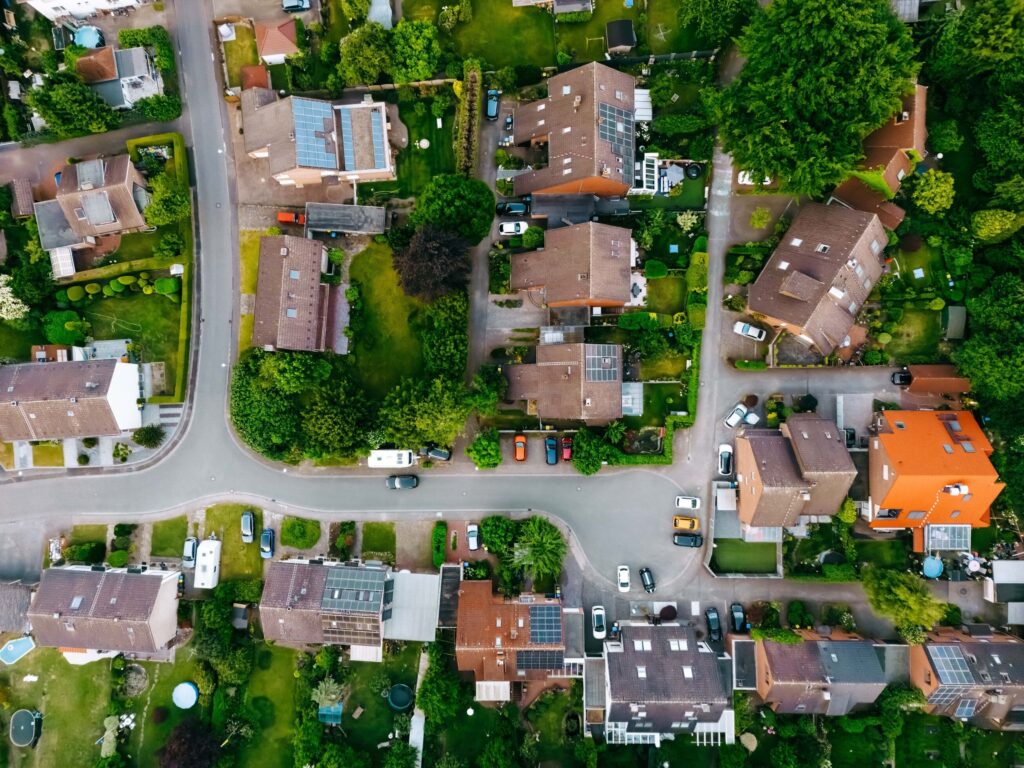
Anyone looking to build in a residential area today faces a unique set of challenges. Often, the focus is not only on the planned structure but also on what already surrounds it: adjacent buildings, narrow driveways, sensitive soil conditions, and, last but not least, a neighborhood that understandably has little patience for noise and vibrations.
In cases like these, a simple shallow foundation is simply not enough. Traditional pile-driving methods face technical and legal limitations. The solution? A bored pile foundation that is precisely tailored to the requirements of modern residential construction projects: quiet, vibration-free, and reliable—from the first drill hole to the final pile cap.
In this article, you’ll learn why this foundation method is particularly well-suited for construction projects in residential complexes, what advantages it offers, what you should keep in mind during the planning phase, and why it’s worth relying on an experienced partner and expert in deep foundations.
Table of Contents
Key Points at a Glance
Bored pile foundations are a specialized deep-foundation method used wherever the soil lacks sufficient bearing capacity—for example, in soft soil layers, areas with high groundwater levels, or densely developed residential areas. Instead of placing the building directly on the ground, bored piles are driven several meters deep into the ground, reinforced, and filled with concrete. This creates a stable pile system that safely transfers loads to deeper, load-bearing layers.
This method really comes into its own in urban areas: It is quiet, vibration-free, and suitable even for narrow excavation pits or sensitive environments such as schools, historic buildings, or courtyards. At the same time, it offers high load-bearing capacity, long-term stability, and can be easily adapted to the specific soil conditions. For anyone who wants to play it safe in residential areas, bored pile foundations are often not only the most attractive option but also the only sensible choice.
What is a bored pile foundation?
Anyone who wants to build in a residential area quickly runs into a major problem: the ground isn’t stable enough. This is because soft clay, layers of peat, or backfilled soil are often insufficient to support the weight of a building over the long term. This is exactly where bored pile foundation —a method from the field of specialized civil engineering that creates stable foundations even where the soil reaches its limits.
The principle is simple but effective: First, a vertical hole is drilled into the ground using a drilling rig—depending on soil conditions, for example, with a Kelly rotary drill or a rotary table with casing. Next, a reinforcing cage is inserted, which provides the resulting pile with additional stability. Finally, the borehole is filled with concrete. This creates a load-bearing concrete pile that is anchored deep in the ground.
A structure typically rests on several of these piles. Together, they form the foundation and ensure that the loads are safely transferred to deeper, load-bearing soil layers. This is essential, especially on building sites with soft soils such as clay, peat, or highly permeable, uniform sand, to prevent future settlement and structural damage.
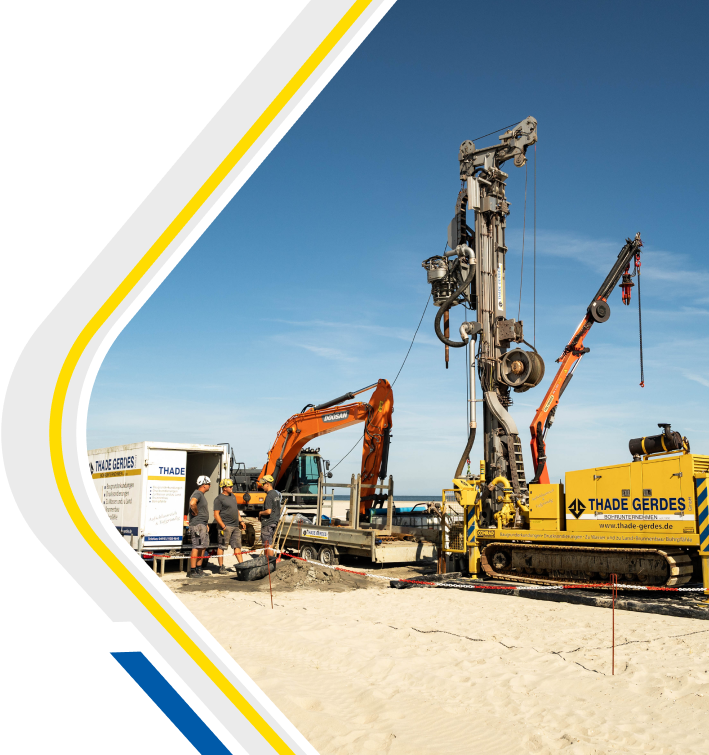
A major advantage of this method lies in the way it is carried out: bored piles are not driven into the ground but are installed using rotating movements. This results in neither vibrations nor loud hammering noises. Instead of the sound of a metal hammer, only the steady hum of the drill can be heard. This reduces noise pollution to a minimum—an important factor in densely populated residential areas.
For neighboring buildings, this also means: no risk of settlement cracks, no wobbly walls, and no resulting structural damage. Drilled-shaft foundations thus protect not only your own construction project but also the surrounding buildings. This is why it is the preferred foundation method for many engineering firms, especially for sensitive projects—such as those in downtown areas, near historic buildings, or where there is little distance to neighboring houses.
Here's How Drilled Pile Foundations Work in Detail
A bored pile foundation is not a standard procedure that is simply “carried out” mechanically. It is a precisely planned foundation engineering concept that is tailored to each project, the specific soil conditions, and the on-site requirements. Drilled-shaft foundation construction involves five key phases, which we’ll outline for you in this section.
1. Site Analysis and Planning
The first step is a thorough investigation of the building site. Experts conduct soil investigations and test drilling to determine which soil layers are present and how stable they are. This process determines whether layers such as peat, clay, sand, or fill material are present in the subsoil and at what depth stable layers are located. The water content of the building site is also assessed, as a high water table can significantly influence the choice of foundation method.
This data is used to prepare a geotechnical report, which serves as the basis for the subsequent design of the piles. This process determines not only whether bored piles will be used, but also which pile system is best suited to the existing soil conditions. Careful planning prevents unpleasant surprises, such as settlement, construction delays, or costly rework.
2. Sizing and Design of the Piles
Once the geological conditions have been determined, the technical design of the piles begins. The design specifications include the length, diameter, type of reinforcement, spacing, and depth of the piles. This involves precisely calculating how much load must be transferred through the piles into the load-bearing strata and determining the best way to achieve this, taking into account skin friction and tip pressure.
Depending on the requirements, the design may call for various pile systems. For example, micropiles may be considered in confined spaces; in loose sand or silty soil, Kelly bored piles with casing are appropriate; while in difficult groundwater conditions, partial- or full-displacement bored piles may also be used. Design is based on applicable standards, such as DIN EN 1536 or DIN EN 12699, and takes into account not only the pure load-bearing capacity but also building code, economic, and environmental considerations.
3. Construction Site Setup and Use of Equipment
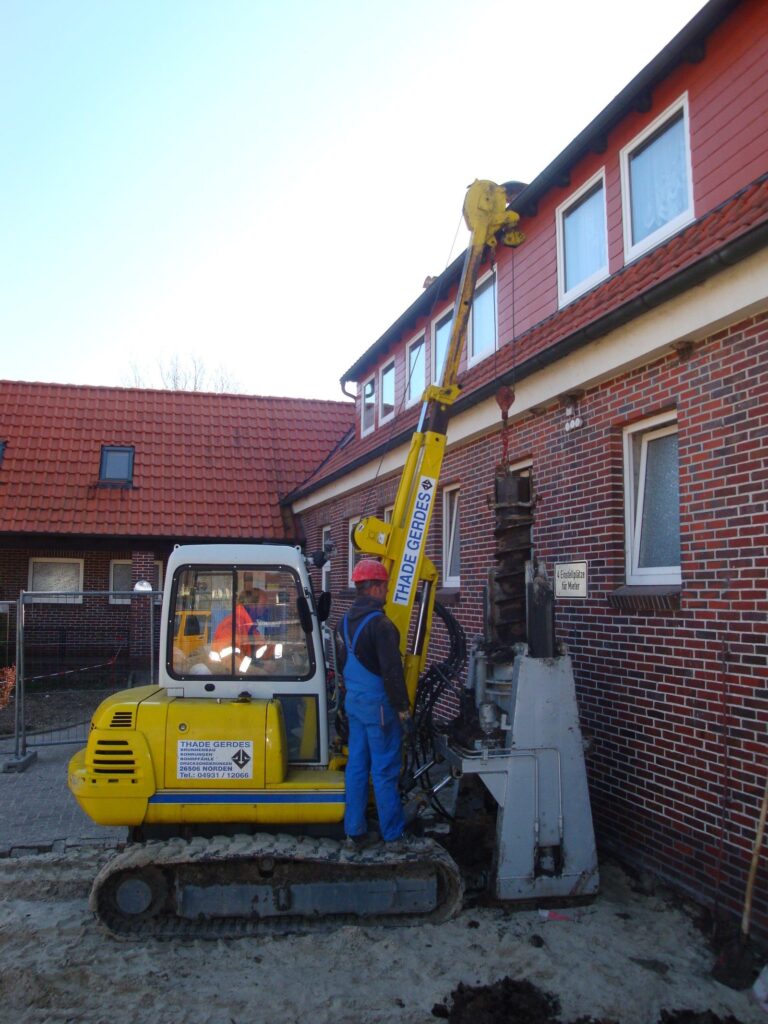
Before the first drilling operation begins, the construction site is set up. This includes securing the site, creating access roads, installing noise or splash barriers as needed, and providing the necessary equipment. Depending on accessibility, project size, and pile system, a suitable rotary drilling rig or a machine with a casing rotary table is used. Compact machines are used on small inner-city lots, while more powerful equipment is used for larger excavation pits.
Logistical coordination is crucial in this process. Only when all components—from the drilling rig and the concrete pump to the transport of the rebar cages—are precisely coordinated can a smooth workflow be ensured.
4. Construction of the bored piles
Now the production of the piles begins. First, the borehole is drilled to the planned depth: Either using a Kelly rotary drilling method, in which the drilling tool mechanically penetrates the ground—in cases of unstable soil or water ingress, casing is additionally installed to stabilize the borehole.
Or using displacement methods, in which the cuttings are displaced to the side and a portion is removed. Once the final depth is reached, the reinforcing cage—which is delivered pre-assembled—is installed. The reinforcement provides the necessary tensile strength and helps distribute the load. The pile is then filled with concrete, typically from the bottom up, to prevent air pockets. Depending on the system, self-compacting concrete may also be used.
This process is repeated for each individual pile. At each step, a check is performed to determine whether the specified lengths have been maintained given the actual soil conditions encountered. This is the only way to guarantee the pile’s future load-bearing capacity.
5. Completion and Review
After the concrete has been poured and allowed to cure briefly, the pile head—the part that will later be connected to the foundation slab or basement floor—is exposed. The pile head is cut cleanly and trimmed to the required height. This is followed by a quality control inspection, which—depending on the scope of the project—may include integrity tests as well as static or dynamic load tests. These tests verify whether the pile can support the planned loads and whether its actual load-bearing capacity matches the calculated value.
Once all inspections have been completed, the work is documented in a report, which will also play a role later during the final building inspection. Only then is the foundation considered complete, and structural construction can begin.
Comparison with Other Types of Business Formation
Not every construction project requires bored piles, but in many cases, this type of foundation is significantly safer than other foundation methods. The comparison shows how bored pile foundations differ from traditional alternatives such as driven pile and shallow foundations—in terms of technology, cost, scope of application, and risk.
| Criterion | Bored Pile Foundation | Pile driving | Shallow foundation |
| Processes | Drilling, Reinforcing, Pouring Concrete | Driving precast piles | Concrete slab or strip foundation directly on the ground |
| Noise & Vibrations | Very low, ideal for residential areas | Loud and highly vibrating | Low, but often associated with earthwork |
| Suitable for residential areas | Yes, even recommended | Generally unsuitable due to noise and vibration | Possible only on soil with good bearing capacity |
| Soil Requirements | Can also be used on poor soil | Load-bearing soil at moderate depth required | Suitable only for soil with uniform bearing capacity |
| Equipment Applications | Compact Kelly rotary drilling rigs, displacement drilling rigs, auger drilling rigs, micropile systems | Large, heavy pile drivers required | Conventional excavators and formwork equipment |
| Vibration Protection | High – no significant impact on adjacent buildings | Low – Risk of cracks and damage to neighboring buildings | No risk, but limited applicability |
| Load Capacity | Very high – lateral friction + peak pressure can be utilized | High, but depends on the ground | Low to medium, depending on the ground |
| Planning Certainty | Precisely calculable, compliant with standards | Limited planning possibilities with unpredictable soil conditions | Easy to plan when the soil has been thoroughly investigated |
| Costs (estimated) | 300–500 €/m² | 250–400 €/m² | 150–250 €/m² |
| Long-term stability | Very high—decades of stability | High, if constructed correctly | Low if the ground gives way |
| Use in the City | Very well suited | Hardly practical | Realistic only with optimal ground conditions |
Conclusion: Drilled-pile foundations offer clear advantages over other options for many residential construction projects, especially in cases of problematic soil conditions or limited space. Shallow foundations may seem more cost-effective, but in the long term they often cause significant damage due to settlement. Pile foundations are highly effective but are generally unsuitable for residential areas due to vibration and noise.
5 Reasons Why Drilled Pile Foundations Are Essential in Residential Areas
Anyone building in a residential area quickly faces challenges quite different from those encountered on an undeveloped lot on the outskirts. The subsoil, the structural conditions, and the proximity to other buildings all require a special degree of consideration, precision, and a foundation method that can accommodate all of these factors. That’s exactly what bored pile foundations are designed for. In this section, we’ll outline the key reasons why this deep foundation method is the only viable option in residential areas.
Reason 1: Building Safely Despite Challenging Soil Conditions
Many residential areas—especially in northern Germany or in urban settings—have soft, loose, or uneven soil layers. Clay, peat, fill material, or sandy soils with low compaction are not uncommon. These are not stable enough to provide long-term support for a house—especially not for multi-story buildings.
With bored pile foundations, loads can be effectively transferred to deeper, load-bearing soil layers. The upper, unstable soil zone is deliberately bypassed in the process. This results in a stable foundation—even under difficult geological conditions. This makes this type of deep foundation particularly safe and durable.
Reason 2: No risks to neighboring buildings
Residential complexes are usually densely built-up. Anyone planning to build a new structure must take into account existing buildings, garages, additions, or retaining walls in the immediate vicinity. Traditional pile-driving methods that generate significant vibrations cannot be used here without risking structural damage.
Drilled-pile foundations, however, offer a vibration-free alternative that allows for foundation work to be carried out without endangering adjacent structures. Thanks to the low-vibration drilling method, the soil remains undisturbed, and no dynamic forces are generated that could be transmitted to neighboring foundations. This is a crucial safety factor—especially on narrow lots and near sensitive structures—and represents a decisive advantage when it comes to potential liability issues down the line.
Reason 3: Starting a Business Without Permitting Hurdles
In many construction zones today, strict guidelines regarding vibration control are in place—for example, near older buildings, historic landmarks, schools, or medical facilities. Even minimal vibrations can be problematic in these areas.
Drilled-shaft foundations, on the other hand, are ideally suited to meet these requirements: Thanks to state-of-the-art rotary drilling technology—such as the Kelly drilling method or partial-displacement drilled piles—installation is virtually vibration-free. This minimizes the impact on the surrounding soil and protects adjacent foundations. This method truly demonstrates its strengths, especially in areas where sensitive building structures must be preserved. It also remains relatively quiet in terms of noise levels—a real advantage for projects where consideration for the surroundings is essential.
Reason 4: Protection of the neighborhood & compliance with building codes
One aspect of construction in residential areas that is often underestimated: the neighborhood. Noise, dirt, work that causes significant vibrations, or extended construction hours can quickly lead to conflicts with nearby residents or even with the building department.
Many municipalities therefore explicitly require low-vibration foundation methods for certain properties or project types, or make them a condition of the building permit process. Drilled-shaft foundations offer a twofold advantage here: It reliably meets all technical standards—such as the requirements of DIN EN 1536 and DIN EN 12699—as well as environmental regulations and legal requirements. At the same time, its quiet, precise operation helps prevent conflicts with neighbors. This makes it the preferred method for construction projects subject to specific requirements.
Reason 5: Smooth Construction Process Despite Limited Space
Many residential construction projects are built on small lots, in courtyards, or in infill areas. There is simply no room here for heavy pile drivers, wide access roads, or large excavation pits.
However, drilling rigs, such as those used in the construction of bored piles, are more compact, mobile, and can be adapted to a variety of site conditions. Even small construction sites in courtyards, on urban lots, or during renovations of existing buildings can be reliably developed with foundation technology using these machines, without having to tear up the entire neighborhood.
Advantages of bored pile foundations in residential areas
✔ Various pile systems depending on requirements
Whether Kelly bored piles, micropiles, partial-displacement piles, or full-displacement piles: The choice of pile can be precisely tailored to the specific soil conditions.
✔ High load-bearing capacity through targeted load transfer
Loads are transferred in a controlled manner to deeper layers via peak pressure and lateral friction, making this ideal for multi-story buildings or high point loads.
✔ Compatible with eco-friendly construction methods
Since the amount of excavated material is reduced and disruption to the subsoil is minimal, this method is also suitable for environmentally sensitive areas such as those near rivers, lakes, or marshes.
✔ Permanently stable and maintenance-free
Once installed, a bored pile supports a foundation for decades, regardless of weather conditions, ground movements, or near-surface erosion.
✔ Easily integrable with a wide variety of foundation types
Bored pile foundations can be easily combined with slab foundations, basement floors, or combined foundations.
Here's What You Should Keep in Mind for Your Construction Project
Whether it’s a single-family home, a multi-family housing project, or an addition, thorough preparation is crucial for construction projects in residential areas. Choosing the right type of foundation, taking technical requirements into account, and coordinating with neighbors and authorities can determine the course and success of the entire project.
A sound bored pile system begins with a professional soil investigation. This should be conducted early on—ideally before purchasing the property or during the early design phase. This is the only way to identify and avoid risks posed by unfavorable soil layers, high groundwater levels, or compaction issues at an early stage.
The planning of pile foundations should not be taken lightly either. In addition to structural analysis, selecting the appropriate pile system, and technical design, building code requirements must also be taken into account. These include protection of neighboring properties, vibration measurements, noise control requirements, and any necessary permits.
Experience and precision play a crucial role in the execution of the work itself. A clean borehole, the exact placement of the reinforcement, and proper backfilling with concrete directly influence the piles’ subsequent load-bearing capacity. Quality controls, documentation, and, when necessary, load tests should be standard practice—especially for sensitive construction projects in urban areas.
If you want to play it safe, it’s worth having a partner by your side who is familiar with bored pile foundations in tight, urban spaces—just like Thade Gerdes.
With over 125 years of experience in specialized civil engineering, a specialized fleet of machinery, and DVGW-certified processes, Thade Gerdes is the right partner for challenging construction projects. Whether it’s partial-displacement bored piles in a cramped backyard or in challenging geological conditions: here you’ll receive a fully integrated, professionally planned solution—including comprehensive consultation during the planning phase. Instead of vague promises, you’ll get clear explanations, dedicated points of contact, and the assurance that your foundation will last for years to come. Contact your deep foundation now.
Conclusion: That's why you need bored pile foundations for your construction project in a residential area
Drilled-pile foundations are much more than just a deep-foundation method. They are the ideal solution for the complex requirements of modern construction projects in residential areas. Whether the ground conditions are challenging, space is limited, or neighboring buildings need to be protected: this method allows for the creation of foundations that are not only load-bearing but also neighbor-friendly, low-noise, and future-proof. Anyone building today should not rely on short-term solutions, but rather on thorough planning, professional execution, and a pile system that delivers long-term results.
If you are planning a construction project in the city, in a confined space, or on unstable ground, you should have your deep foundation professionally inspected. With over 125 years of experience in specialized civil engineering, Thade Gerdes is here to support you as a reliable partner—from soil investigation to the final borehole. Take this opportunity to put your project on a solid foundation from the very beginning and contact us now your deep foundation now.
Frequently Asked Questions About Drilled Pile Foundations in Residential Areas
How much does a bored pile foundation cost?
Depending on the scope of the project, soil conditions, and pile system, costs typically range between 300 and 500 euros per m² of foundation area. The price may vary in cases of complex soil conditions or confined construction sites. An early soil investigation report provides a reliable estimate.
When is a bored pile foundation necessary?
Whenever the building site is not stable enough—such as in the case of peat, clay, fill soil, a high water table, or uneven soil compaction. This foundation method is also often the only option for buildings with heavy loads or in sensitive environments (e.g., densely built-up residential areas).
What is the difference between bored pile and driven pile foundations?
In the case of drilled-shaft foundation , the foundation is carefully constructed by drilling ,, whereas with pile driving , prefabricated piles are driven into the ground with high impact force. The latter causes significantly more noise and vibrations, so it is generally unsuitable in residential areas.
How long does it take to construct bored piles?
Depending on the length of the stakes, soil conditions, and the number of stakes, the time required is usually 1 to 3 days per 10 piles. Smaller construction projects can be completed within a few days, while larger projects require a slightly longer lead time.
What does "skin friction" mean in the context of piles?
The surface friction describes the portion of load transferthat occurs via the lateral friction between the bored pile and the surrounding soil . It complements the tip pressure and significantly increases the bearing capacity of the entire pile system.
Is it possible to use bored pile foundations even when space is limited?
Yes, that’s exactly what it was designed for. With compact drilling rigs or micropile systems, even tight courtyards, urban lots, or narrow excavation pits can be safely developed—without extensive excavation, without heavy pile drivers, and without causing a disturbance to the neighborhood.

