

Table of Contents
Before planning a foundation, it is essential to determine just how load-bearing the subsoil actually is. This is exactly where cone penetration testing comes into play. This method allows for a quick and precise assessment of how the soil behaves under load.
In a pressure probe test, a measuring probe with a conical tip is pressed into the ground. This test records two key values: tip pressure and skin friction. These values indicate the resistance offered by the soil and the composition of the subsoil.
In this article, you will learn how a cone penetration test (CPT) is conducted, how tip pressure and skin friction are generated, and how these measurements are analyzed. You will also see how these results are used to make specific decisions regarding shallow foundations or pile foundations.
Key Facts About Pressure Sounding at a Glance
- In a cone penetration test (CPT), a probe with a conical tip is driven into the ground. The tip pressure and skin friction are measured to determine the properties of the subsoil.
- Continuous measurement along the penetration depth produces a diagram of the subsoil structure. Changes in the measured values indicate layer transitions, soil types, and differences in compaction density.
- Important soil parameters can be determined from the analysis of the measurement data, such as bearing capacity, soil structure, or indications of sand, silt, or clay in the subsoil.
- The results of the pressure sounding serve as the basis for evaluating the soil conditions and help in deciding between shallow foundations and pile foundations.
- In practice, pressure probing is often combined with drilling to obtain as complete a picture as possible of the subsoil structure.
1. How a Cone Penetration Test (CPT) Is Conducted
The pressure probing method, known internationally as the Cone Penetration Test (CPT), is an indirect method of soil investigation—that is, one that does not involve sampling. In this method, a probe with a conical tip is continuously pushed into the ground. As it penetrates, the probe records variations in soil resistance every 2 cm.
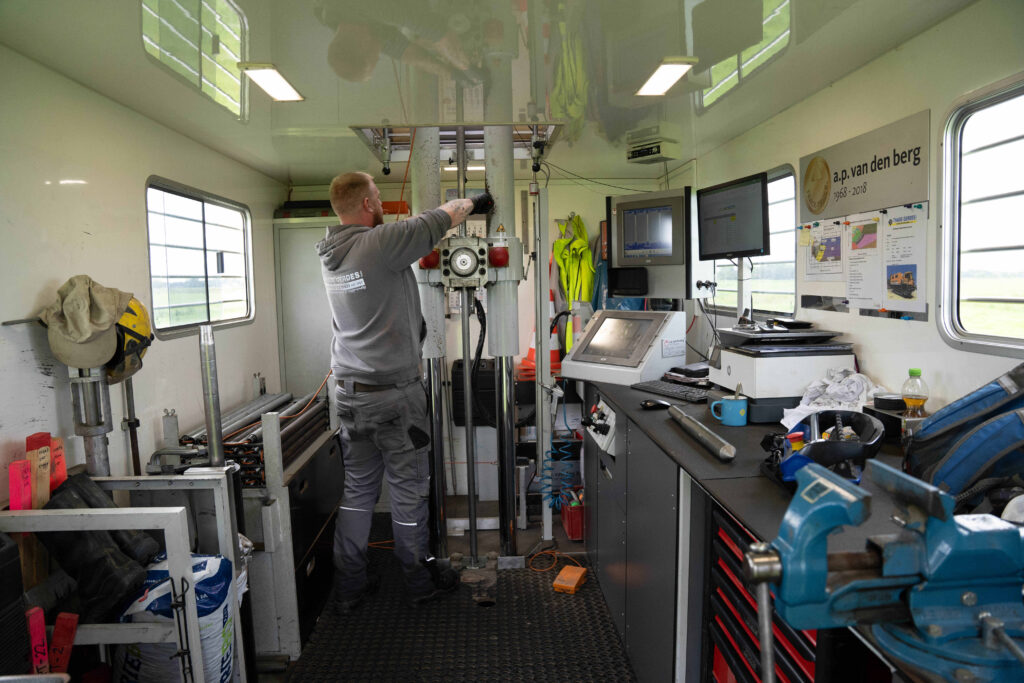
The pressure probe consists of two main components: a cone at the tip and a cylindrical sleeve behind it. Both sections measure different forces in the soil. The probe is hydraulically pressed into the ground via a linkage. The penetration rate remains constant to ensure that comparable measurements are obtained.
Depending on the soil conditions, test drilling to a depth of about 30 meters is possible. During the driving process, all measurement data is recorded directly in the measurement head and displayed in real time on a laptop. This makes it immediately reveals how the subsoil changes at depth.
Tip Pressure: What the Measuring Tip Detects in the Soil
The tip pressure (qc) is measured directly at the tip of the probe. As the probe penetrates, the measuring tip encounters resistance from the ground.
The greater this resistance, the higher the measured peak pressure will be. High values indicate dense or load-bearing soil layers. Low values, on the other hand, indicate loose sand, soft soil, or organic layers.
The peak pressure thus provides key information about the bearing capacity of the subgrade and the compaction density of the soil.
Friction Between the Mantle and the Probe: What Forces Act Along the Probe?
In addition to the tip pressure, pressure probing also measures the shell friction (fs). This friction occurs along the cylindrical shell directly behind the tip of the cone.
This measurement range captures the friction between the soil and the probe during penetration. The magnitude of the skin friction depends heavily on the soil type and soil structure.
Cohesive soils, such as clay or silt, typically produce higher skin friction. Pure sand, on the other hand, often results in lower friction values. As a result, skin friction provides important insights into the composition of the subsoil.
Soil Index: How Soil Types Are Determined from Measurement Data
Another parameter can be calculated from the ratio of tip pressure to skin friction: the ground index.
This value is used to classify the soil based on the measurement data. This makes it possible to determine whether the subsoil consists primarily of sand, silt, or clay.
The soil index thus combines both parameters from the pressure sounding and allows for an initial classification of the soil type directly from the measurement data.
2. How a soil profile is created from measurement data
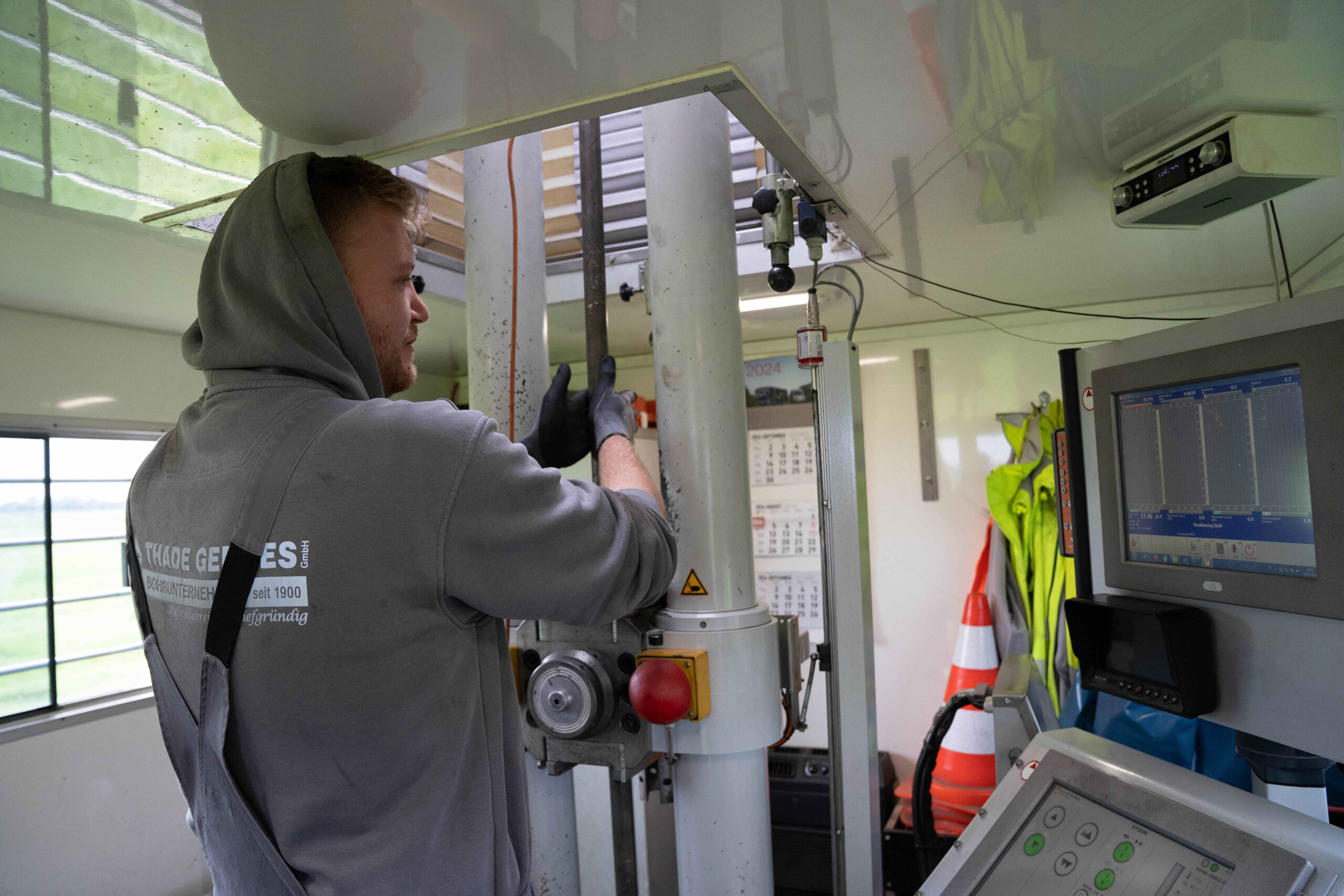
During the pressure probing test, the probe is continuously pressed into the ground. As this happens, the measuring probe continuously records values for peak pressure, skin friction, and other parameters. Any change in the subsurface directly affects these measurements.
The recorded measurement data is used to create a graph showing penetration depth. Depth is plotted on the vertical axis, while the measured resistances are plotted on the horizontal axis. This process gradually builds a profile of the subsoil.
If the resistance in the soil changes, the curve on the graph also changes. Any significant change indicates a change in soil layer. In this way, the structure, thickness, and properties of the individual soil layers can be identified.
Identifying changes in soil layers
Changes in stratification are often indicated in the diagram by sudden changes in peak pressure. If the value rises sharply, this usually indicates a denser or more load-bearing soil layer.
If the values remain consistently high over several meters, this often indicates a load-bearing layer in the subsoil. Such layers are particularly relevant for foundation design.
In contrast, widely fluctuating measurement values may indicate inhomogeneous soils, backfill, or varying soil types. In such areas, the soil structure often changes at short intervals.
Assess Bearing Density and Load Capacity
The peak resistance provides important information about the soil’s compaction state. Especially in sandy soils, the compaction density can be accurately determined from the measured peak pressure.
High peak resistances usually indicate a compacted sand layer. Such layers generally have a higher bearing capacity and are better suited for supporting the load of a structure.
Low peak resistances, on the other hand, indicate loose sand or soft soil. These layers are more sensitive to loading and may settle more significantly under certain conditions.
The relationship is clear: The denser the soil, the greater its bearing capacity tends to be. This information is crucial for planning the foundation.
3. Why Construction Site Observations Remain Important
A pressure sounding provides precise measurements of the subsoil. However, to ensure a reliable assessment of the subsoil, additional observations made directly at the construction site are also taken into account. These include, among other things, the results of visual inspections of soil samples taken from boreholes.
This supplementary information helps to better interpret the data from the pressure sounding and to obtain a complete picture of the subsoil structure.
Ground Contact During Drilling
During drilling, the soil is brought directly to the surface. This makes it possible to identify different types of soil right on the construction site.
Sand, silt, and clay differ significantly in grain size, color, and texture. These characteristics are used to make an initial assessment of the soil type.
This visual assessment of the soil is conducted prior to laboratory testing as part of what is known as a field assessment. The observations are then compared with the data obtained from the cone penetration test. This provides a reliable assessment of the soil structure.
4. What Pressure Sounding Means for Your Foundation
The analysis of a pressure sounding does not end with the soil profile. What matters most is what conclusions can be drawn from it regarding the foundation of a structure. The measured values indicate whether the soil near the surface can support loads or whether load-bearing layers are found only at greater depths.
Depending on the soil conditions, there are two typical scenarios.
When a Shallow Foundation Is FeasibleA shallow foundation is an option when load-bearing soil layers are present even at shallow depths.
Typical notes on the CPT diagram:
- Consistently high peak resistances near the surface
- only minor fluctuations in the measured values
- several meters of homogeneous, load-bearing soil layers
- a consistent, low floor index
In such cases, a building’s load can be transferred directly to the subsoil via foundations or a floor slab.
When Pile Foundations Are NecessaryNot every type of subsoil has sufficient bearing capacity in the upper layers. Measurements often initially show low peak resistances before stable layers are reached at greater depths.
Typical notes in the measurement profile:
- soft or loose soil layers in the upper section
- Bearing layers are found several meters below the surface
- A significant increase in peak resistance at depth
In this case, piles are used to transfer the structure’s loads to these deeper layers.
Pressure probing determines whether pile foundations are necessary and at what depth the stable subsoil begins. This information plays a key role in determining the required pile length and the foundation design.
5. Characteristics of Northern German Soils
The soil conditions in northern Germany regularly present planners with unique challenges. Large parts of the landscape consist of marsh, bog, or coastal soils, whose properties differ significantly from those of typical sand or gravel soils. It is precisely here that dynamic probing provides important information about bearing capacity and soil structure.
Marshes and bogs: soft soils with low bearing capacity
In many regions of northern Germany, marsh and peat soils predominate. These soils often contain a high proportion of organic matter and have a very soft texture.
In the pressure sounding diagram, such soils are usually indicated by very low peak resistances. The probe can penetrate the subsurface relatively easily because the soil offers little resistance.
For construction projects, this often means that the soil near the surface has limited bearing capacity. Layers with sufficient bearing capacity are often found only at greater depths.
Sandy coastal areas and groundwater
Sandy soils are also found in coastal regions. Sand can generally have good bearing capacity, especially when it is compacted.
However, groundwater is a crucial factor. When water is present in the soil’s pore space, the load-bearing behavior changes. Loose, water-saturated sands are more sensitive to loading and can deform more significantly.
Pressure probing helps to reveal these differences. By analyzing the peak resistance and other measured values, it is possible to determine how densely the sand is packed and how the subsoil behaves under load.
6. Pressure Sounding in the Project: From Measurement Data to Foundation Design
Pressure probing provides precise measurements of the subsoil. However, its full significance can only be realized through expert interpretation within the context of the project. A diagram alone is not sufficient to make informed decisions about the future foundation.
In practice, the results of pressure probing are therefore combined with additional tests. These often include boreholes that provide direct information about the soil conditions at the construction site. Only the combination of these methods can reliably reveal the actual composition of the subsoil.
At the same time, the analysis is always conducted with the planned structure in mind. Whether it involves crane sites, infrastructure projects, or pile foundations, the requirements for the subsoil vary significantly from project to project. Subsoil composition, groundwater, and bearing capacity also play a key role in construction projects in coastal areas or offshore.
The goal of the site investigation is therefore to produce both a measurement diagram and a precise basis for foundation design. Specific conclusions regarding bearing capacity, soil density, and possible foundation systems are derived from the measured values.
Particularly for construction projects in northern Germany—both on land and at sea—pressure probing is often combined with supplementary investigation methods. This provides a reliable overall picture of the subsoil, which is directly incorporated into the foundation design.
Thade Gerdes conducts such investigations as part of site investigations and deep foundation projects. In this process, CPT tests, supplementary boreholes, and on-site observations are evaluated together to design stable foundations.
Are you planning a construction project and need reliable data on the building site? Then contact a load test.
If it turns out that load-bearing soil layers are found only at greater depths, special foundation methods are used. Learn more here more about deep foundations and other services in special civil engineering.
Your Benefits with Thade Gerdes
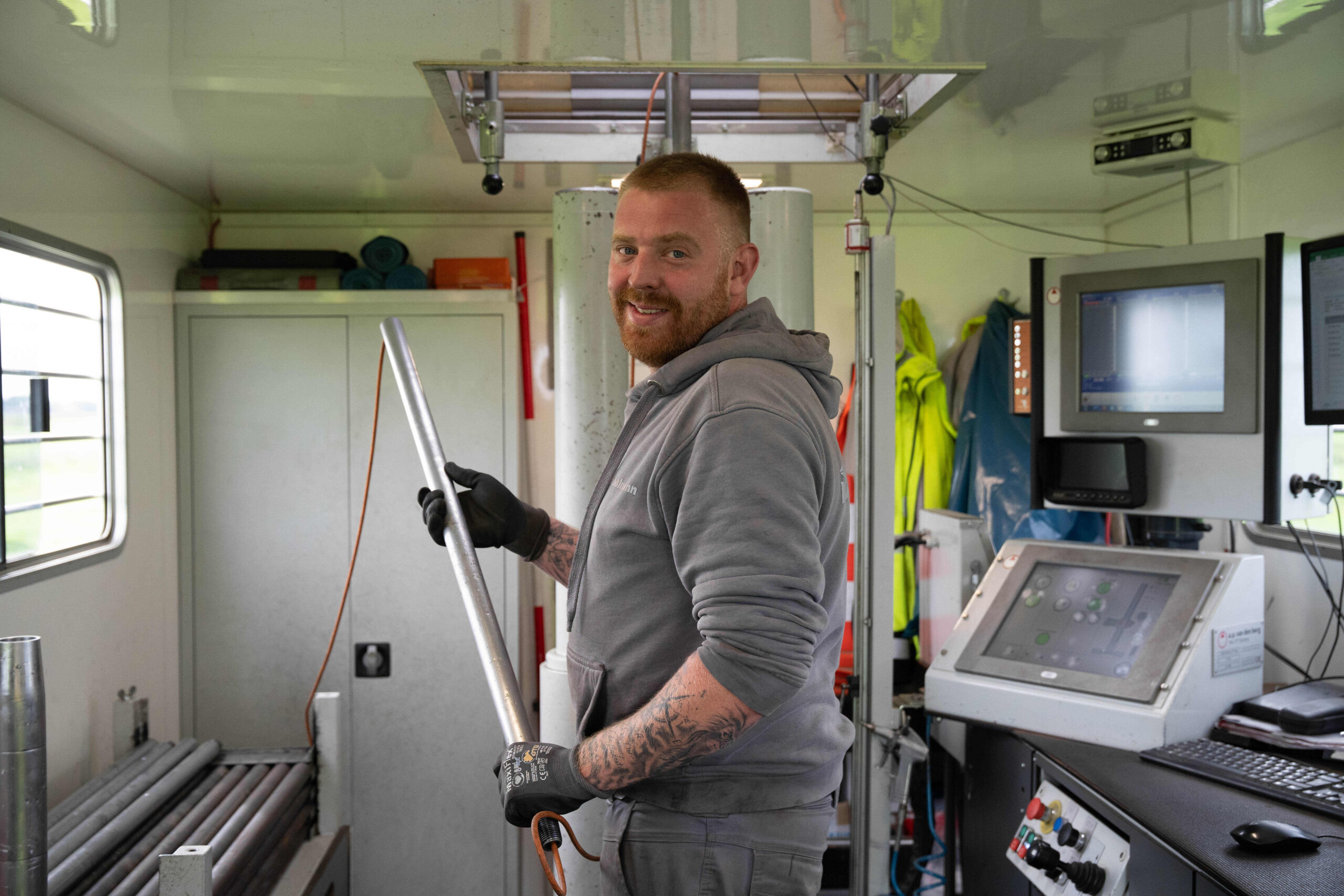
In construction projects, the outcome depends not only on the site investigation but also on the experience of the contractor. Thade Gerdes combines site investigation, cone penetration testing, and specialized civil engineering with decades of practical experience and structured processes.
✔ More than a century of experience in specialized civil engineering
For more than 125 years, Thade Gerdes has been working with building sites, foundation systems, and technical concepts in civil engineering. This expertise is incorporated into every project, from the initial site analysis to the implementation of the appropriate foundation.
✔ Gentle Methods for Sensitive Construction Environments
The drilling and foundation methods used are vibration-free and produce minimal noise. This is particularly important in densely built-up areas, near existing buildings, or for projects with strict environmental protection requirements.
✔ Foundations on Land and in Water
Whether conducting soil investigations on conventional construction sites or working along shorelines and in bodies of water, the teams at Thade Gerdes reliably install foundations under a wide range of conditions in accordance with applicable standards.
✔ Structured Processes for a Quick Project Start
The work steps are organized from planning through site investigation to the provision of equipment. This ensures that your construction project can begin without unnecessary delays.
✔ Clear Quotes and Predictable Investments
All services are listed in a structured manner. You’ll receive a transparent cost estimate and know early on which tasks are included in the project scope.
✔ Reliable Scheduling
Coordinating all phases of construction ensures that your project stays on schedule. This applies to both individual site investigations and complex deep foundation projects.
✔ Work in Accordance with Certified Environmental Standards
With its DVGW W120-1 certification, Thade Gerdes meets the requirements for working in water-bearing soil layers. This ensures that the soil and groundwater are protected as effectively as possible during construction work.
✔ A Dedicated Point of Contact Throughout the Project
You’ll have a direct point of contact throughout the entire project phase. This ensures that agreements remain clear and that project progress is transparent at all times.
✔ Experience with Private and Public Construction Projects
Whether it’s an infrastructure project, commercial construction, or a private construction project: Thade Gerdes carries out foundation work under a wide variety of conditions and delivers reliable results for planning and construction.
Are you planning a construction project and want to have the building site reliably surveyed? Then request a dynamic load test directly and let Thade Gerdes advise you on the appropriate testing methods.
7. Conclusion: Why Pressure Sounding Supports Construction Decisions
Conus Penetration Testing (CPT) is one of the most important methods of geotechnical investigation. By measuring tip pressure and side friction, it is possible to reliably determine soil structure, compaction, and bearing capacity. The continuous measurement data is used to create a detailed soil profile that shows the composition of the subsoil at depth.
This information forms the basis for key decisions in the construction project. It helps determine whether a shallow foundation is sufficient or whether a pile foundation is necessary. Combined with additional investigations, such as boreholes, it provides a complete picture of the subsoil.
Are you planning a construction project and would like to have the building site reliably assessed early on? If so, you can request a request a cone penetration test and get advice on the appropriate soil investigation. Thade Gerdes supports you with his experience in specialized civil engineering, from soil investigation to the implementation of the appropriate foundation.
8. FAQ: Frequently Asked Questions About Pressure Sounding
What is a cone penetration test?
The pressure probing test, known internationally as the Cone Penetration Test (CPT), is an indirect geotechnical investigation method used to assess the subsoil. In this test, a probe with a conical tip is continuously pressed into the ground. During penetration, the probe measures various parameters such as tip pressure, skin friction, and other data points. This data provides important information about the soil profile, soil structure, and the bearing capacity of the subsoil.
What measurements are recorded during a pressure sounding?
During a pressure sounding, the measuring probe records several important values:
- Peak pressure (qc) at the measuring tip of the pressure probe
- Sleeve friction (fs) along the friction sleeve behind the tip
- in some cases, additional parameters such as pore water pressure
These measurement data show the resistance the soil offers as the probe penetrates it. By combining these values, it is possible to determine the soil type, compaction density, and other soil parameters.
How is a CPT test conducted?
During a pressure sounding test, the probe is pressed into the ground using a hydraulic system via a linkage. The penetration rate is standardized and is usually about 2 centimeters per second.
The probe is often driven into the ground by a special probing vehicle or a truck equipped with a counterweight. During the penetration (the “pushing” phase), a measuring head continuously records the data. This data is displayed directly as a graph and forms the basis for the subsequent pressure sounding report.
Which standard governs pressure probing?
The performance of CPT tests is governed by the DIN EN ISO 22476-1 standard. This standard specifies the requirements for equipment, measurement procedures, speed, measurement parameters, and documentation.
These standards ensure that the results of pressure soundings are comparable, traceable, and technically reliable.
What types of soil can be identified using a cone penetration test?
Pressure probing provides information about different soil types. Typical examples include:
- Sand with varying bulk densities
- Silt
- Clay or other cohesive soils
- Peat
By analyzing peak pressure and skin friction, conclusions can be drawn about soil structure, angle of friction, shear strength, and bearing capacity.
How deep can a pressure sounding be performed?
The achievable penetration depth depends on the soil conditions and the technique used. In many projects, cone penetration tests reach depths of up to about 30 meters.
In very firm soil, the penetration depth may be shallower, while in softer soil, greater depths are possible.
What are the results of the pressure sounding used for?
The results of pressure testing provide important insights for construction projects. Among other things, they are used for:
- the assessment of the bearing capacity of the foundation soil
- the design of shallow foundations or pile foundations
- Analysis of the Subsoil Structure
- The Analysis of Soil Parameters in Soil Mechanics
The measurement data help planners and engineers realistically assess the subsoil and select the appropriate foundation for a structure.
What role does pressure probing play in geotechnical investigations?
Pressure probing is an important method of soil investigation. It is often used in conjunction with boreholes and laboratory tests.
Combining these investigations provides a comprehensive picture of the building site. The results serve as the basis for a well-founded assessment of the subsoil and the subsequent foundation.

