


Table of Contents
You’re planning a construction project and are faced with the question: Is a shallow foundation sufficient, or is a deep foundation necessary? This is precisely where the greatest uncertainties arise, because the decision depends not only on the building itself, but also on the soil conditions.
In this article, we’ll use real-world projects to show you how such decisions are made in practice. You’ll learn why one construction project might require only a few piles, while another might need dozens. We’ll also explain the role that factors such as soil composition, loads, and site conditions play in this process. This will give you a clear understanding of when deep foundations are necessary and how they’re actually implemented.
Key Points at a Glance: Examples of Deep Foundations:
Examples of deep foundations show that the choice of foundation always depends on the soil conditions: Soft layers near the surface or heterogeneous soils make it necessary to transfer the load to deeper layers.
From just a few piles to complex systems with over 100 piles, the design depends directly on the loads, construction method, and existing conditions.
In addition to the soil conditions, factors such as confined construction sites or adjacent buildings also influence the choice of method, such as low-vibration pile foundations.
When do construction projects require deep foundations?
The decision regarding a specific type of foundation is not based solely on empirical data, but is determined directly by the building site. Each location has its own soil conditions, and it is precisely these conditions that determine whether a shallow foundation is sufficient or whether a deep foundation is necessary.
Typical reasons for deep foundation work include:
- Soft, low-bearing soils in the upper layers.
- Soil layers that vary significantly or are non-uniform.
- High loads from the structure that cannot be dissipated near the surface.-
It is important to note that without reliable data on the soil conditions, it is impossible to make a sound decision. Only through tests such as cone penetration tests can one determine at what depth load-bearing layers are located and how loads can be safely transferred.
Deep foundations are always required when the soil near the surface cannot reliably support the structure’s loads. In this case, the forces are transferred via piles to deeper, load-bearing layers, thereby creating the foundation for a structurally sound and durable building.
Deep Foundation Example 1: Residential and Commercial Building in Neuharlingersiel
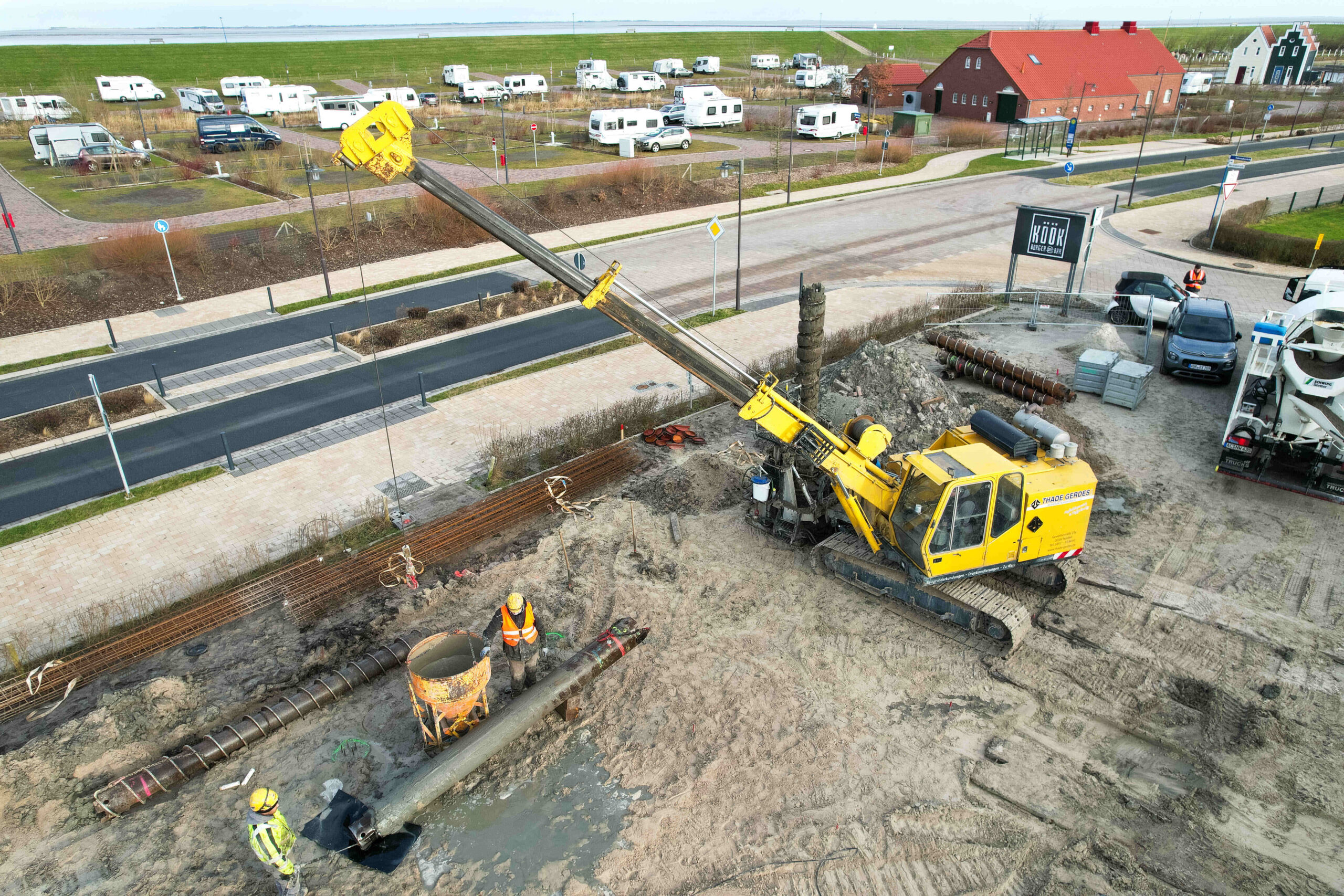
The residential and commercial building in Neuharlingersiel clearly illustrates how strongly regional soil conditions influence foundation design decisions. In coastal locations such as this one, the upper soil layers often consist of soft sediments with low bearing capacity that would give way under load. A conventional shallow foundation would have led to uneven settlement here and, consequently, to damage to the building.
To eliminate this risk, 24 piles, up to 9 meters long, were driven into the ground. The goal was to specifically transfer the building’s loads past the near-surface, non-bearing layers and into deeper, stable soil layers. Only there is uniform and permanent load transfer possible.
The project makes it clear that the number and length of the stakes are not random. They result from two key factors:
- Depth of the load-bearing layers: Sufficiently load-bearing soil is not reached until several meters below the surface.
- Building Loads: Residential and commercial buildings generate significantly higher loads than single-family homes.
In northern Germany in particular, this initial situation is not an exception, but rather the rule. Coastal regions, peatlands, and former marshlands are characterized by soft soils that make direct foundation construction virtually impossible.
Therefore, the same process is always crucial: Only a site investigation can reveal how deep the load-bearing layers lie. This information is then used to determine the required pile length and the overall foundation design.
This example shows that deep foundation work is not a “safety margin,” but rather a direct response to the actual on-site soil conditions.
Deep Foundation Example 2: Expansion of the Rastede Outdoor Pool

The expansion of the outdoor pool in Rastede illustrates how deep foundation work becomes significantly more complex as soon as an existing structure is incorporated into the project. Unlike with a new construction, not only must new loads be taken into account here, but also the existing structure itself.
In this specific project, a total of 85 + 54 piles, with lengths of up to 13 meters, were installed. This large number stems from the particular challenge of connecting two different load conditions:
- An existing building whose structural behavior has already been determined
- An expansion project that generates additional loads and must be integrated into the existing system
The piles serve a dual purpose. On the one hand, they safely transfer the new loads from the expansion to deeper, load-bearing soil layers. On the other hand, they ensure that the existing structure and the new building settle evenly, preventing any differences in settlement.
The large number of piles, in particular, is no coincidence but was deliberately chosen: it distributes the loads over a larger area and reduces the risk of differential settlement between the existing and new structures.
The project highlights what is important when it comes to building stock measures:
- Existing foundations are sensitive to additional loads.
- Different settlement rates can lead to cracks or damage.
- The foundation must “synchronize” the two systems—the old and the new—with each other.
This is precisely where the particular challenge lies: Deep foundations in existing building projects are not just a matter of load-bearing capacity, but above all of coordinating the existing and new building structures.
Deep Foundation Example 3: Jaderberg Grocery Store
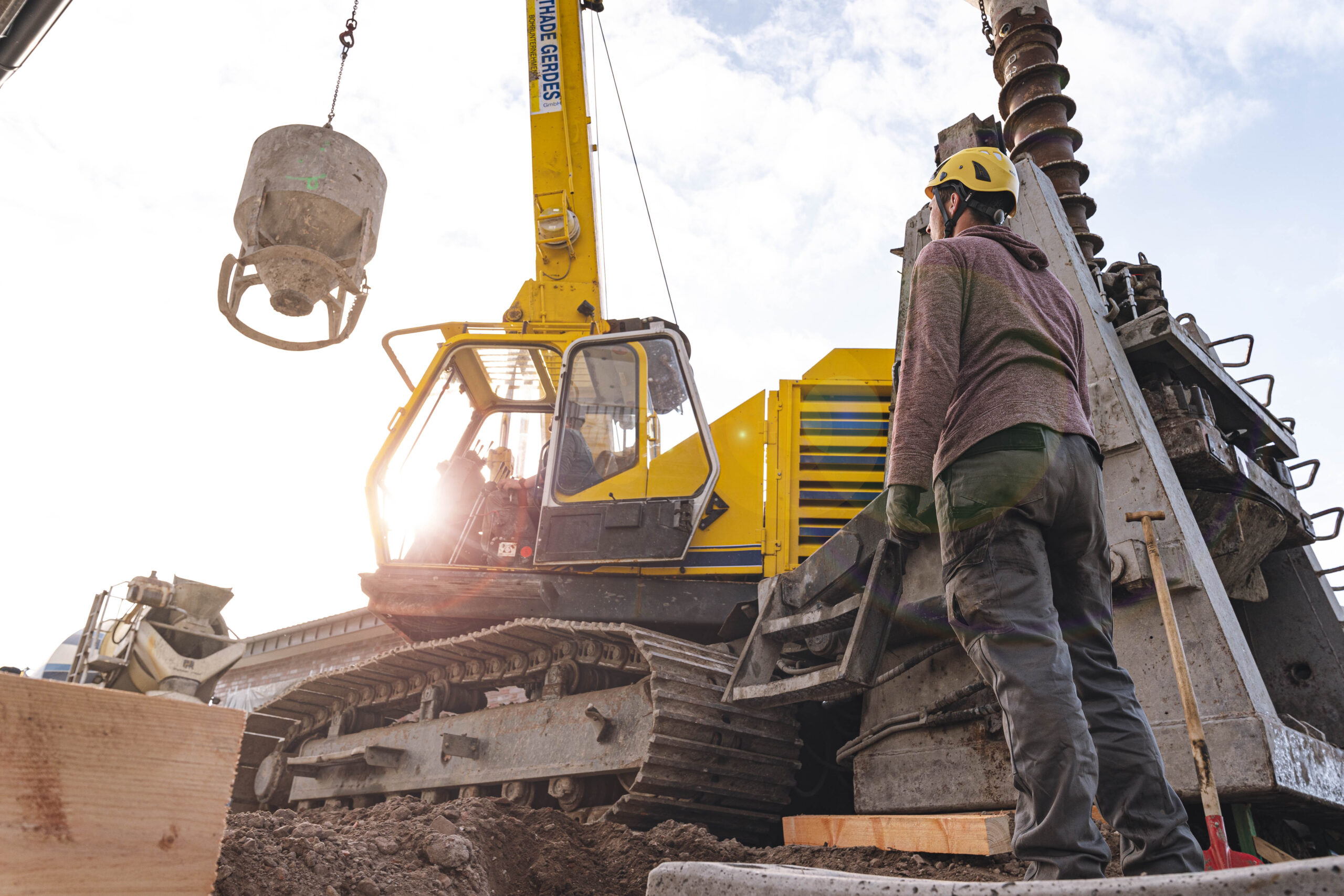
When constructing a new grocery store in Jaderberg, the focus was not only on the building site but, above all, on the conditions at the construction site itself. The property was surrounded by existing buildings, which placed correspondingly high demands on the design of the foundation.
The following were used: 9 displacement auger piles with lengths of up to 9 meters. This method was deliberately chosen to ensure that the foundation work with minimal vibration while ensuring the necessary load-bearing capacity.
The background: On confined construction sites with adjacent buildings, traditional pile-driving methods are problematic. The vibrations generated by these methods can affect surrounding structures or even cause damage. That is precisely why a drilling method that does not produce strong vibrations was chosen for this project.
An additional advantage of displacement auger piles lies in the installation process itself: During installation, the soil is not removed but is displaced to the sides and compacted in the process. This further improves the bearing capacity of the surrounding soil—an effect not seen with other methods.
The project clearly shows:
- The choice of foundation method depends not only on the building site.
- The surroundings of the construction site also influence the technical implementation.
- Low-vibration methods are crucial when there are sensitive neighboring structures.
This example makes it clear that deep foundation systems are always planned within the overall context: the building site, the structure, and the construction site conditions are directly interrelated.
Deep Foundation Example 4: Hangar at the Norddeich Airfield
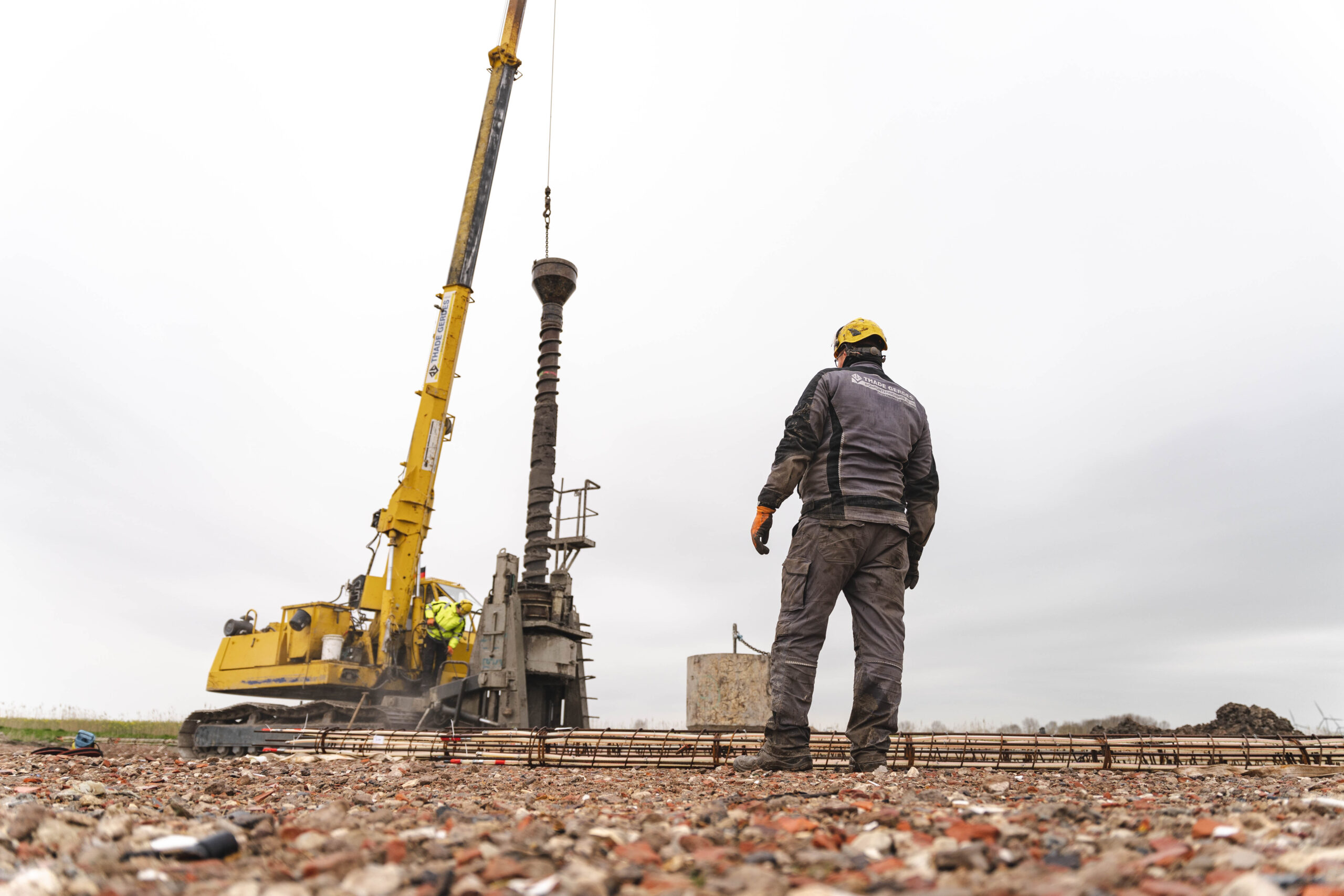
The hangar at the Norddeich airfield demonstrates that deep foundations must do more than just fulfill a structural function. In this project, the foundation was deliberately designed to serve an additional technical purpose.
The following were used 51 energy piles, ranging in length up to 16 meters. These not only support the hangar’s load but also serve as part of a geothermal energy system. Pipes integrated into the piles allow energy to be extracted from or supplied to the ground for heating in the winter and cooling in the summer.
Thus, the foundation serves a dual purpose:
- Load Transfer: Safe transfer of building loads to deeper, load-bearing strata.
- Energy Generation: Utilizing the heat stored in the ground to power buildings.
The advantage lies in combining both requirements into a single component. No additional space or separate systems for energy generation are required; the foundation itself becomes part of the building’s technical infrastructure.
The project clearly shows:
- Deep foundations can serve purposes beyond mere load-bearing.
- Energy piles combine foundation engineering with building services engineering.
- This creates an additional benefit—especially for larger structures—without requiring any additional effort in terms of land use.
This example illustrates that modern deep foundations not only provide stability but can also actively contribute to a building’s energy efficiency.
This Is How Proper Deep Foundations Are Constructed in Practice
In practice, the key factors are:
- Depth of the load-bearing layers: The pile length is directly determined by the depth at which sufficiently load-bearing soil is encountered. Only at that depth can loads be safely supported.
- Size and Load of the Structure: The number of piles depends on the size of the building and how the loads need to be distributed across the area. A greater load requires more piles to ensure even load distribution.
- Site Conditions and Soil Structure: Soft or heterogeneous layers near the surface mean that shallow foundations are insufficient and deep foundations are required.
- Groundwater conditions: Aquifers have a significant impact on bearing capacity and the choice of foundation system.
- Site conditions: Confined spaces or adjacent structures determine which installation method is used, e.g., low-vibration methods instead of pile driving.
An Overview of the Benefits of Working with Thade Gerdes
✔ More than 125 years of experience in the field of soil mechanics and deep foundations
→ Ensures well-founded assessments in specialized civil engineering and reduces uncertainties as early as the planning phase.
✔ Targeted use of reinforced drilling methods
→ Minimizes noise and vibrations and is particularly suitable for projects in existing buildings or in sensitive environments.
✔ Integration of Site Investigation and Foundation Construction
→ All steps are closely interlinked, thereby preventing coordination issues between planning and execution.
✔ A Structured Project Workflow from the Very Beginning
→ Planning, permits, and implementation are coordinated so that construction projects can begin without unnecessary delays.
✔ Transparent Quotation Preparation
→ Provides a reliable basis for cost estimation without unexpected additional costs as the project progresses.
✔ Designed in accordance with current guidelines for soil and groundwater protection (DVGW W120-1)
→ Ensures safe installation even in challenging, water-bearing soil layers.
✔ A dedicated point of contact throughout all project phases
→ Technical questions are resolved directly, without lengthy coordination processes.
✔ Implementation for residential and commercial construction projects
→ From single-family homes to large-scale projects, the foundation is precisely tailored to the loads and soil conditions.
Book your free, no-obligation initial consultation with Thade Gerdes!
Conclusion: Practical examples provide a clear picture of deep foundation systems
The examples of deep foundations shown here make it clear: There is no one-size-fits-all method for the right foundation. The specific soil conditions, the loads on the structure, and the conditions at the construction site are always the deciding factors.
Whether it’s coastal soil, a renovation project, or a cramped construction site: Every project has its own unique requirements. That is precisely why a sound decision is always based on a thorough soil investigation and planning tailored to its findings. Only once it is clear at what depth load-bearing layers are located and how the loads must be distributed can the appropriate foundation system be determined.
With Thade Gerdes, you have a specialized contractor for deep-excavation projects that directly combines site analysis and deep foundation work. Find out now check whether deep foundations are is required.
Frequently Asked Questions About Examples of Deep Foundations
When is deep foundation work necessary?
Deep foundations are necessary when the upper soil layers cannot safely support the loads of a structure. This is often the case with soft, cohesive, or heavily saturated soils. In such situations, the loads must be specifically transferred to deeper, load-bearing layers to prevent settlement and damage.
What factors determine the choice of the right deep foundation?
The choice of the appropriate deep foundation method always depends on several factors at once. These include the soil conditions, the loads imposed by the structure, and the local conditions at the construction site. Groundwater conditions and adjacent buildings also play an important role in selecting the appropriate method.
How is the length of the piles determined in pile foundation construction?
The length of the piles depends directly on the depth at which load-bearing soil layers are present. This information is determined through site investigations such as soil probing or drilling. The goal is to drive the piles deep enough to ensure safe and permanent load transfer.
Why do deep foundations vary so much from project to project?
Every type of building site has different characteristics. For this reason, the number, length, and type of piles vary considerably depending on the location. In addition, the building’s intended use, the construction method, and the surrounding environment also influence the specific design of the deep foundation.
What are the advantages of low-vibration deep foundation methods?
Low-vibration methods are particularly important in densely built-up areas or for construction projects involving existing structures. They reduce the impact on surrounding buildings and minimize the risk of damage caused by vibrations. At the same time, they enable precise and safe execution even under difficult job site conditions.
What are energy posts, and when are they used?
Energy piles are specialized foundation elements that, in addition to providing structural support, are also used to harness geothermal energy. Pipes integrated into the piles make it possible to extract or transfer heat from the ground. They are primarily used in larger construction projects where structural integrity and energy efficiency need to be combined.
Why is a soil investigation so important before constructing a foundation?
A site investigation is the foundation of any sound foundation design. Without precise knowledge of the soil composition, neither the bearing capacity nor the necessary measures can be reliably determined. It provides the critical data needed to minimize risks and implement the appropriate foundation in a way that makes economic and technical sense.

