

Choosing the right foundation is the cornerstone of every successful construction project—in the truest sense of the word. After all, an inadequate deep foundation can have disastrous consequences: settlement, cracks, costly repairs, or—in the worst-case scenario—the complete collapse of a structure. Careful planning of the foundation is essential, especially when building in areas with soft soil, high groundwater levels, or unstable subsoil.
But how can you make the right choice? In this article, we’ll show you the different types of deep foundations and their respective advantages and disadvantages. You’ll also learn what you absolutely must consider when choosing the right foundation and what mistakes you should avoid.
Table of Contents
Key facts about the types of deep foundations:
There are various types of deep foundations, such as pile foundations, bored pile foundations, and diaphragm wall construction. Each has its own specific advantages and disadvantages. Careful planning is essential, as it ensures that the chosen method provides the necessary stability while also optimizing construction time and costs.
Common mistakes, such as inadequate geotechnical investigations, can lead to problems. In addition, you should take future developments and changes in the construction area into account when selecting the appropriate foundation. |
What is a deep foundation?
Deep foundation is a specialized construction technique. It makes it possible to erect structures on non-load-bearing soil. Deep foundations are necessary when the surface soil layers are not firm enough to support the weight of a building. This is particularly the case in areas with soft soil. But deep foundations also provide the necessary stability when the planned structure is very heavy, such as a high-rise building.
| ⚠️ Without deep foundations, heavy buildings cannot be adequately supported on soft soil. This can lead to serious damage to the building structure or even collapse! |
How does deep foundation differ from shallow foundation?
Deep foundations differ from shallow foundations mainly in the depth at which the foundation is anchored. With deep foundations, the foundation is driven deep into the ground to reach more stable soil layers. This is necessary when the surface soils do not provide enough stability to support the weight of the structure.
In contrast, with shallow foundations, the foundation is built directly on the surface layers of stable soil without penetrating deep into the ground. Shallow foundations are used exclusively in stable soils.
An Overview of Deep and Shallow Foundations
Shallow Foundation | Deep Foundation |
Use only on stable, load-bearing soils, e.g.:
| Can be used on soft, non-load-bearing soils, such as:
|
Smaller, relatively lightweight buildings, such as:
| Also ideal for large and heavy structures, such as:
|
💡 Germany has a complex soil composition—ranging from coastal regions with soft sandy soils to mountainous regions with irregular layers of rock and scree. In many cases, this requires deep foundations.
What types of deep foundations are there?
A wide variety of deep foundation techniques are used in the construction industry. Each type of deep foundation has its own specific applications, advantages, and disadvantages. In general, deep foundations are used to safely transfer the weight of a structure to deeper, more stable soil layers. The selection of the right method depends on several factors, including soil conditions, the load on the structure, and the depth to which the foundation is installed.
Pile Foundation
Pile foundations are one of the oldest and most commonly used methods of deep foundation construction. In this process, piles are driven or drilled into the ground to transfer the weight of the structure to deeper, more stable soil layers. This method is primarily used when the surface soil does not provide sufficient bearing capacity, such as in marshy soils.
Subtypes of Pile Foundations
- Driven pile: This type of pile is driven mechanically into the ground. It is ideal for soils that can be easily compacted. However, it is also used in hard soils where the pile is more difficult to drive. The advantage of driven piles is that they can be installed quickly and cost-effectively.
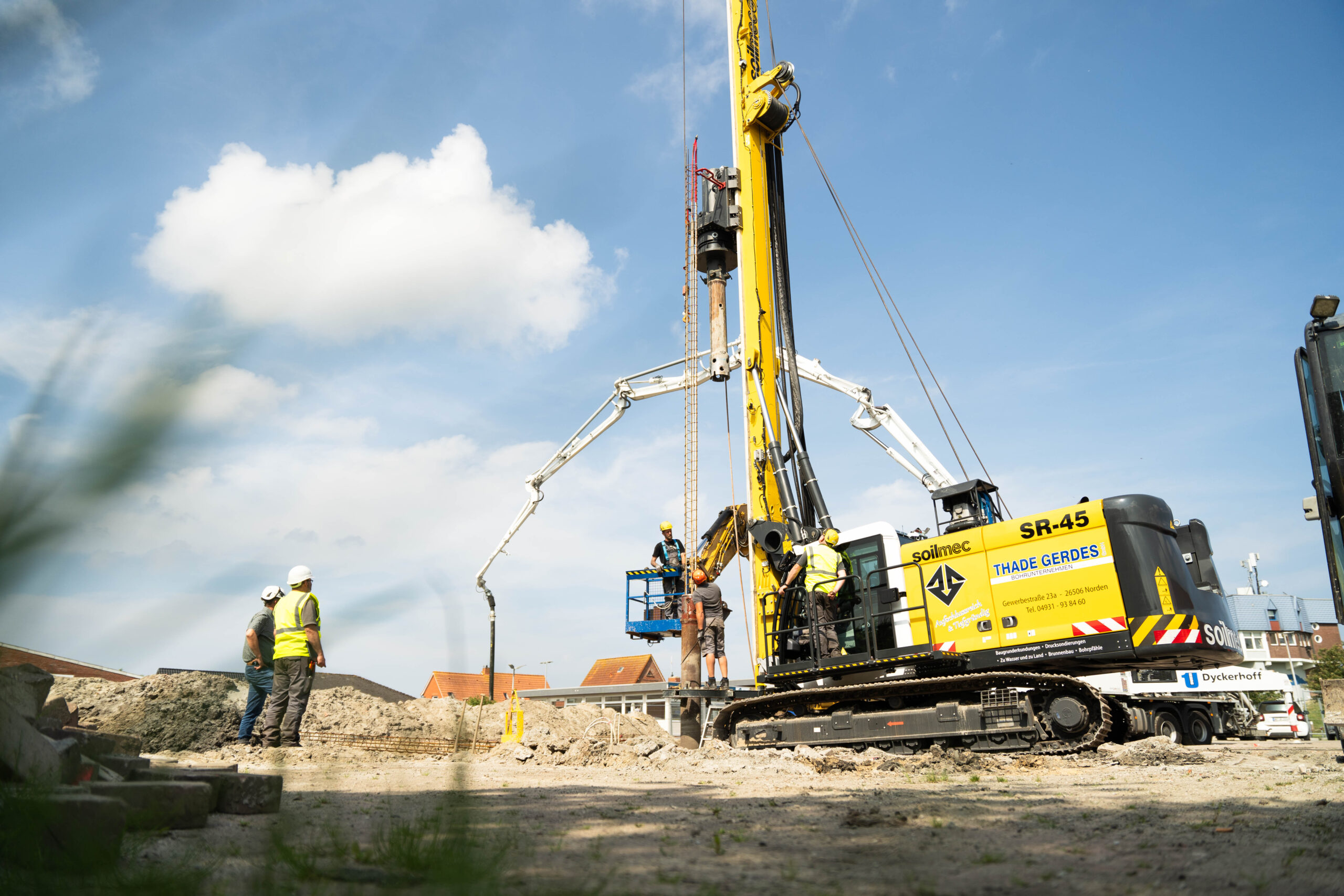
- Bored Pile: The bored pile is not driven into the ground but is installed without causing vibrations by drilling into deeper soil layers. This method is particularly useful in densely built-up areas or in urban settings, where minimizing vibrations and noise is essential for noise protection. Furthermore, it does not generate vibrations that could cause damage to neighboring buildings. It is one of the most adaptable methods, as the pile is suitable for nearly any soil structure and provides high load-bearing capacities.
- Micropile: Micropiles are particularly well-suited for renovations and smaller construction projects. They are ideal for expanding existing buildings or stabilizing structures in urban areas. This option is perfect when space is limited but a moderate load-bearing capacity is required.
- Screw pile: This is a relatively new technique in which screw piles are driven into the ground. This method is quick and easy, especially in soft soil. Screw piles are particularly suitable for temporary construction projects or areas where a stable foundation with only low load-bearing capacity is needed quickly.
- Displacement bored piles: These are a special type of bored pile installed using a unique technique. This method has proven to be particularly efficient, as a large portion of the soil is displaced and does not need to be disposed of at great expense. Displacement bored piles are particularly suitable for the foundations of heavier structures.
Advantages and Challenges of Pile Foundations
✅ Advantages: Pile foundations offer excellent load-bearing capacity, especially in areas with soft or unstable soil. They enable the construction of structures subject to high loads that would not be possible with conventional shallow foundations. In addition, they are generally faster and more cost-effective than other deep foundation methods.
❌ Challenges: Pile foundations involve high initial costs. In addition, some installation processes, such as driving piles, can cause noise and vibrations. This can be particularly problematic in urban areas.
Well Construction
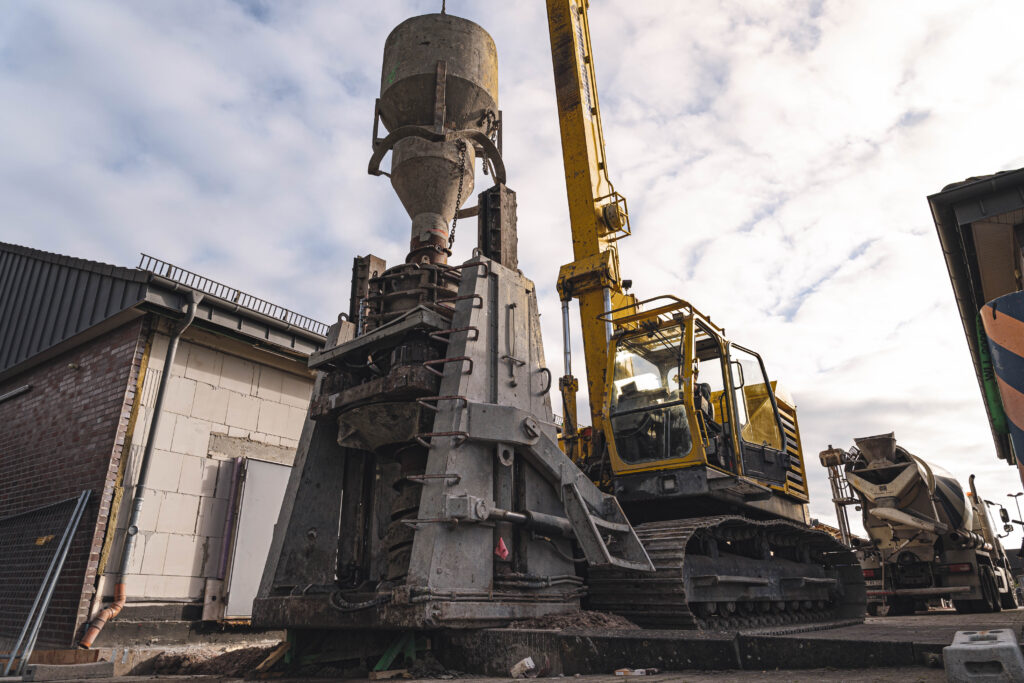
Well foundation construction is particularly important for construction projects in areas with high groundwater levels. This method is frequently used for underground structures such as subway shafts or large excavation pits, where groundwater can pose a significant challenge. In well foundation construction, a borehole is drilled into the ground, into which concrete rings (known as well rings) or caissons are then installed.
Advantages of Well Construction
✅ High stability: Well foundations offer excellent stability and are particularly advantageous in areas with a high water table.
✅ Watertight Constructions: Well foundations can act as watertight barriers. This makes them ideal for construction in areas with high water tables or in buildings with basements.
Disadvantages of Well Foundation Construction
❌ High costs: Well foundation construction is one of the most expensive deep foundation methods. This is because it requires specialized equipment and a complex construction process.
❌ Technical Challenges: Installing wells can present technical difficulties. This is because deep drilling is required and large volumes of water must be removed.
Diaphragm Wall Method
In the diaphragm wall method, a deep, vertical wall (the diaphragm wall) is excavated into the ground. This is done by digging a narrow, deep trench, which is then filled with a special mixture of concrete and water to keep the trench stable. Once the trench has been excavated, the wall is poured with concrete to form a stable and watertight barrier. The diaphragm wall method is particularly suitable for the construction of underground parking garages and subway shafts.
Advantages of the diaphragm wall method:
✅ Waterproofing: The diaphragm walls prevent water from entering the excavation—an ideal barrier against groundwater.
✅ Stability: This method ensures high stability of the excavation pit and protects the project from settlement or soil slippage.
✅ Adaptability: Diaphragm walls can be used in various soil types.
Disadvantages of the diaphragm wall method:
❌ Cost: The process is expensive and time-consuming because it requires specialized machinery and materials.
❌ Complexity: It requires precise planning and execution to ensure the necessary stability and waterproofing.
Deep Foundations in Practice: Application Examples
Deep foundations are used in many construction projects. In this section, we’ll take a look at some specific real-world examples. They’ll illustrate how different deep foundation methods are used depending on the construction project.
Construction in Venice – A Case for Pile Foundations
Venice is a city built on numerous islands within the lagoon system. This means that the ground beneath the city consists of soft silt and sand. Deep foundations are essential here, as shallow foundations are not sufficient to support the enormous loads of the structures.
In Venice, nearly every building is built on piles that are driven or drilled deep into the ground. This type of foundation ensures that Venice remains a unique and historically significant architectural project.
Offshore Wind Farms – Pile Foundations for High Loads
Offshore wind farms are another example of the use of pile foundations. These massive wind turbines must not only withstand high wind loads but also extreme weather conditions. Pile foundations are used to ensure that the wind turbines remain stable even in strong winds and rough seas.
Pile foundations offer the advantage here of providing stable anchorage even in deeper waters. Especially when dealing with challenging seabed conditions, they are the most efficient design for ensuring the necessary load-bearing capacity and stability.
Bridge Construction – Securing Heavy Loads on Unstable Ground
When building bridges, it is often necessary to construct the structure on unstable or soft ground. Bridges must have an enormous load-bearing capacity, as they must support both the weight of the structure itself and dynamic loads, such as vehicular traffic.
In this case, pile foundations are essential for safely transferring the bridge’s weight to deeper, more stable layers. A combination of bored piles and micropiles is often used to ensure both stability and flexibility.

Planning Deep Foundations: What You Need to Know
Planning deep foundations is a crucial step in any construction project. Various factors must be taken into account, factors that affect both the choice of foundation type and the construction process. Careful planning ensures that the chosen method not only provides the necessary stability but also optimizes the construction process and avoids unnecessary costs.
Factors Influencing the Choice of Deep Foundation Systems
- Soil Type: The soil must be tested for bearing capacity and stability. Soft soils that cannot bear sufficient loads require deeper foundations, such as pile or bored pile foundations.
- Intended Use: Depending on the type of building and its intended use, the loads on the structure must be taken into account. A residential building requires a different level of structural stability than a high-rise or a bridge.
- Construction Time and Costs: In addition to technical feasibility, construction time and costs also play a role. Faster and more cost-effective methods, such as driven piles, are generally used whenever possible.
💡 Don’t underestimate the soil conditions. This mistake is often made when choosing the right type of foundation. Some builders are too quick to opt for a shallow foundation for cost reasons—without checking the soil’s actual bearing capacity.
How much does a pile foundation cost?
The cost of a pile foundation can vary widely, depending on various factors such as the depth and type of piles and the geological conditions of the building site. For example, in cold regions, the foundation must be driven to a depth below the frost line. This is the only way to prevent damage caused by frozen ground. This depth varies depending on the geographic location and must be taken into account during the planning phase.
Overview of Costs by Type of Foundation per Meter
| Driven pile: | 50 and 150 EUR |
| Drilled pile: | 150 to 300 EUR |
| Micropile: | 200 to 500 EUR |
| Screw pile: | 100 to 200 EUR |
| Displacement pile: | 80 to 130 EUR |
Common Mistakes in Choosing Deep Foundations
Choosing the right deep foundation is crucial to the stability of a structure. In practice, however, mistakes are frequently made when selecting the appropriate method. Some of these mistakes can lead to higher costs, longer construction times, or even serious structural problems.
Error 1: Inadequate geotechnical investigation
A common mistake is an inadequate or flawed geotechnical investigation of the building site. Without a detailed analysis of soil conditions and bearing capacity, the wrong type of deep foundation is often selected. This leads either to an oversized foundation (and thus to unnecessarily high costs) or to an undersized foundation, which increases the risk of settlement or structural damage to the building.
Mistake 2: Underestimating Construction Time and Costs
Another mistake is to underestimate the time and costs associated with certain deep foundation methods. Drilled pile foundations and well foundations, in particular, are more costly due to their long construction time and technical complexity. Incorrect budgeting can quickly become a problem in this context.
Mistake 3: Ignoring Future Developments
Sometimes, when planning a deep foundation, the long-term effects and future changes to the construction site are not taken into account. These include, among other things, changes in the groundwater level or the addition of further loads from subsequent construction projects. Such factors can have a significant impact on the stability of the foundation. Therefore, they should under no circumstances be ignored during the planning phase.
Avoid these mistakes in your construction project! If you need assistance with your deep foundation work, schedule a free, no-obligation initial consultation with Thade Gerdes —your expert in deep foundation systems using piles.
Your Benefits with Thade Gerdes at a Glance
👍 More than 125 years of expertise in civil engineering and deep foundation work:
Thanks to our many years of experience, we have the necessary expertise to safely carry out your construction project as well.
👍 Minimal noise emissions:
Our drilling techniques enable noise- and vibration-free deep foundation work.
👍 A wide range of services, both on land and on water:
Our services cover a wide range, from soil investigations to deep foundations—both on land and in bodies of water.
👍 Quick Project Kickoff:
Our well-coordinated team ensures a smooth and swift start to your project—we handle everything from obtaining official permits to coordinating resources so that your project can be implemented quickly.
👍 100% cost transparency:
With us, you always know exactly what you’re paying for. Our transparent pricing structure ensures that you won’t encounter any hidden fees.
👍 Reliable adherence to schedules:
Our experienced project managers ensure that the agreed-upon completion date is met—you can count on us to carry out everything according to plan.
👍 Environmentally Friendly Practices:
Environmentally conscious work is our top priority—we comply with all guidelines for protecting soil and groundwater to preserve the environment. We are certified according to DVGW W120-1.
👍 Personalized Support:
You’ll receive regular updates and have a dedicated contact person who will handle all your questions.
👍 We take on both private and public projects:
Whether for private or public projects—we always deliver reliable and on-time results for your deep foundation work.
Take advantage of these benefits and schedule your free, no-obligation initial consultation with Thade Gerdes!
Conclusion: The Right Deep Foundation for Your Construction Project
Choosing the right deep foundation depends on numerous factors. You must carefully consider these factors to ensure a safe and durable foundation. Whether it’s a displacement bored pile foundation, a bored pile foundation, or a well foundation—each method has its specific applications. They should be selected based on the geological and structural conditions.
When selecting the appropriate deep foundation system, consideration should be given not only to soil conditions but also to the intended use of the structure and the associated loads. A thorough structural analysis and expert consultation are essential to avoid costly mistakes and to establish a stable foundation for the construction project.
Get your construction project off to a safe start and schedule a free, no-obligation initial consultation with Thade Gerdes for your deep foundation work!
Frequently Asked Questions About Types of Deep Foundations
When is a pile foundation necessary?
Pile foundations are necessary when the topsoil does not provide the necessary bearing capacity to support the structure. This is often the case in areas with soft soil, high groundwater levels, or when constructing heavy structures.
What is the difference between a driven pile and a bored pile?
The main difference between a driven pile and a bored pile lies in the construction method. While driven piles are driven into the ground using machinery, bored piles involve drilling a hole in the ground without causing vibrations, into which the pile—reinforced with steel and concrete—is inserted. Drilled piles cause less noise and vibration and are therefore often the preferred choice in urban areas.
How deep does a foundation need to be?
The depth of a foundation depends on soil conditions and the soil’s bearing capacity. As a rule, the required depth ranges from one meter for shallow foundations to up to 20 meters for deep foundations such as pile foundations. In areas prone to frost, the foundation must be placed at least below the frost line, which further affects the depth.
How much does a pile foundation cost?
The cost of pile foundations varies widely depending on the method chosen and the soil conditions. A rough overview of the cost per meter for different types of piles shows:
- Driven pile: 50 to 150 EUR per meter
- Bored pile: 150 to 300 EUR per meter
- Micropile: 200 to 500 EUR per meter
- Screw pile: 100 to 200 EUR per meter
- Displacement pile: 80 to 130 EUR
However, the exact costs depend on other factors, such as soil type, drilling depth, soil investigation, and the specific requirements of the project. In areas with difficult geological conditions or a high water table, costs may be higher. This is because specialized techniques and additional equipment are required.
Why is an inadequate geotechnical investigation a common mistake?
An inadequate geotechnical investigation leads to an incorrect assessment of soil conditions and bearing capacity. This can result in the selection of a foundation that is either oversized or undersized. The consequence is unnecessary costs or damage to the structure.
Why are construction timelines and costs often underestimated?
The actual complexity and time required for deep foundations are often underestimated. Methods such as bored pile foundations or well foundations require specialized equipment and expertise, which make them expensive and time-consuming. An inaccurate cost estimate can therefore lead to budget overruns and delays.
Why should future developments be taken into account when choosing a deep foundation system?
Future changes in the construction area, such as a rise in the water table or subsequent expansions of the structure, can affect the stability of the foundation. These factors should be taken into account during the planning phase to avoid long-term problems and additional costs.

