

Table of Contents
Are you planning a construction project, but the soil isn’t stable enough? Traditional foundation methods quickly reach their technical and economic limits when dealing with compactable layers, heavy loads, or tight schedules. In such cases, a driven-pile foundation ensures structural load-bearing capacity, enables a predictable construction process, and is particularly well-suited for solid or compactable soils. Typical applications include warehouses, temporary structures, or utility containers.
In this article, we’ll show you how the driven-pile foundation method works and when it’s worth using. You’ll learn what you absolutely must keep in mind regarding planning, construction time, and environmental conditions. We’ll also compare this method with alternative pile systems and provide you with practical guidance to help you make a decision for your project.
Key Facts About Driven Pile Foundations at a Glance
- Driven piles are prefabricated foundation elements made of concrete, steel, or wood that are driven into the ground using pile-driving equipment. This method is particularly suitable for load-bearing or compactable soil layers, such as for industrial buildings, bridges, or large-scale, heavy-load foundations.
- Bearing capacity results from point pressure and frictional resistance, depending on the soil profile and pile length. Driven piles are not always the right choice. A comparison with alternatives such as bored piles or micropiles is an essential part of sound decision-making.
- Compared to bored piles, this method offers the advantages of a shorter construction time and lower costs, but it requires more space and generates higher noise levels. Vibration and noise must be assessed early on in sensitive environments and reduced if necessary.
What is a driven-pile foundation?
If you want to prioritize safety when building a foundation, there’s no getting around driven piles. These piles reliably transfer loads to deeper soil layers and are particularly in demand when compactable or solid soils make shallow foundations impossible. But what exactly sets driven piles apart, and for which projects are they truly suitable?
In the following, we take a practical look at the structure, operation, and typical conditions of use for driven-pile foundations.
What are driven piles, and how do they function in the ground?
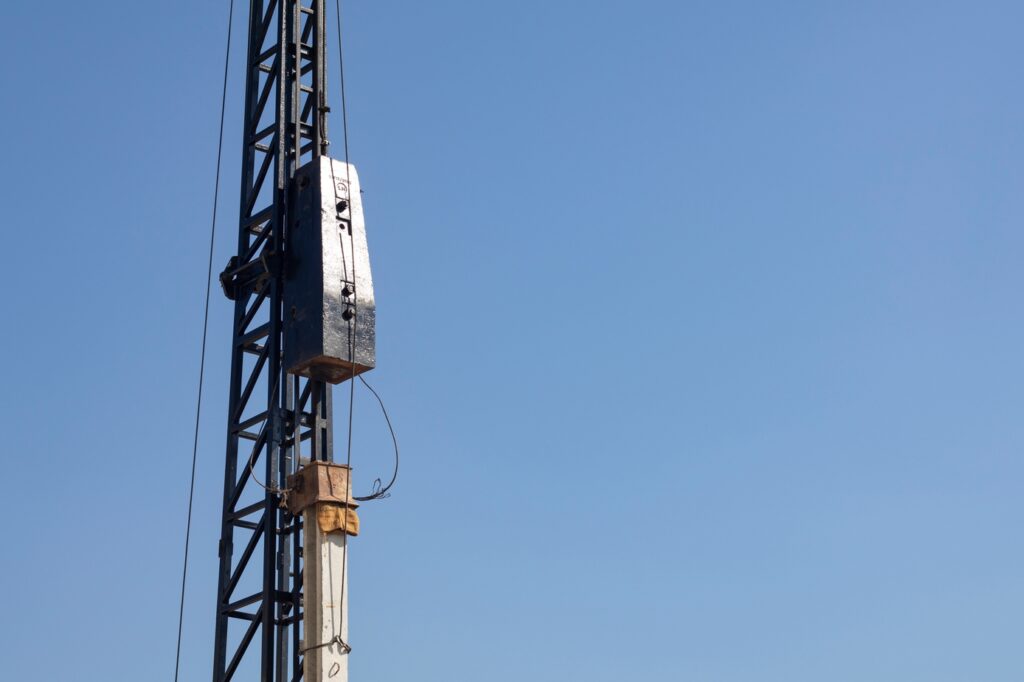
Driven piles are among the load-bearing elements of deep foundations. They are prefabricated piles that are driven into the ground using pile drivers or driving tubes. Depending on the requirements, they are made of reinforced concrete, steel, or wood. The length and diameter are determined by local loads and geotechnical conditions.
The key to how the piles function lies in how they transfer loads. Two mechanisms are at work here:
- Pile tip pressure: The pile anchors into the load-bearing soil layer.
- Sheath friction: Load transfer occurs through friction between the pile shaft and the surrounding soil.
In many cases, these two principles work in combination. The result: a stable, resilient foundation system for a wide variety of structures, from bridges to retaining walls and industrial buildings.
What types of soil are suitable for driven-pile foundations?
Whether driven piles are suitable for your project depends largely on the soil profile. Two main types are relevant here:
- Compactable soils: These include loose sand layers, silt, or soft layers with low internal resistance. In these cases, driving the pile into the ground positions the pile and simultaneously partially compacts the soil, which further increases the bearing capacity.
- Solid Soils: In densely packed, compact layers such as gravel or clay, driven piles quickly achieve high bearing capacities. The high soil resistance has a stabilizing effect here: ideal when the structure must bear heavy loads or when minimal deformation is required.
Especially in regions with highly variable soil layers, this method thus offers a reliable foundation solution, provided that the soil investigation is conducted carefully.
Load-bearing capacity, technology, and depth: Key factors in driven-pile foundations
Not every type of soil provides sufficient support, and not every pile foundation is suitable for every project. Whether a driven-pile foundation is the right choice for you depends on several factors: the required load-bearing capacity, the soil profile, and the planned location. Careful planning at this stage will help you avoid future problems, such as building settlement, and lay the foundation for a permanently stable structure.
The following sections explain how driven piles safely transfer loads and how their load-bearing performance and installation process can be reliably assessed.
This is how driven piles safely transfer structural loads into the ground
The primary function of driven piles is to transfer structural loads deep into the subsoil—safely and without subsequent settlement. In practice, this is achieved through two operating principles:
- In solid soils, driven piles achieve their bearing capacity through tip pressure. This means that the loads are transferred directly into load-bearing, deeper layers, which is ideal for compact soils with high resistance.
- In compactable soils, there is a second effect: driving the piles leads to additional compaction around the pile. This increases the bearing area and also increases the lateral friction, which significantly improves load distribution along the length of the pile.
Experience gained from similar construction projects (field experience) helps to realistically assess how the piles will behave in the specific soil conditions and to adapt the foundation design accordingly.
Piling Performance and How to Identify Reliable Piling Systems
When driving piles, the so-called driving behavior provides valuable information about soil conditions: If the penetration resistance changes suddenly, this often indicates a change in soil layer. Differences in pile length under the same energy input can also indicate inhomogeneous soil layers.
To ensure that these observations are turned into reliable quality data, modern technology is used:
- Pile Load Testing
- Energy Monitoring
- Digital recording of the penetration depth per stroke
This measurement data enables comprehensive monitoring of the installation and provides reliable evidence of structural safety. Especially for load-bearing components that are no longer visible, this documentation is a crucial factor in ensuring long-term reliability.
A Cost Analysis of Driven Pile Foundations: A Comparison of Time, Money, and Performance
If you’re short on time or need to lay many meters of foundation, the foundation method becomes a key factor in cost-effectiveness. A driven-pile foundation can offer a real advantage here: short construction time, clearly predictable processes, and often a cost advantage over more complex methods such as bored-pile foundations. However, it’s important to note that the economic advantage is reflected not only in the price per meter but also in the interplay between construction time, labor requirements, and the conditions of the subsoil.
How much construction time do you save by using driven piles?
Unlike bored piles, where excavation, drilling, reinforcement installation, and concrete placement are carried out sequentially, the driven pile method relies on precast piles and mechanical installation. This means:
- No downtime due to fresh concrete setting
- No removal of excavated material
- Fewer steps on the construction site
Depending on the pile length and soil conditions, driving a pile takes only a few minutes. On average, 20 to 40 piles can be driven per day on a well-organized construction site. This saves time, reduces staffing requirements, and allows for a swift transition to the next phase of construction.
How much does a driven-pile foundation cost, and when is it cost-effective?
The total cost consists of three main factors:
- Pile Construction: Materials (e.g., reinforced concrete), Manufacturing, Transportation
- Installation: Use of a pile driver, pile pipe, machine operator, and alignment
- Logistics and Construction Site Organization: Setup, Access Roads, Storage Areas
Compared to bored piles, time-consuming steps such as drilling, concrete pouring, and excavation disposal are eliminated. This can significantly reduce the total cost per running meter, particularly in the following cases:
- large-scale foundation systems (e.g., industrial buildings or bridges)
- tight time frames in the construction schedule
- Soil that can be driven into without special safety measures
When is this a good investment?
If your project is under time pressure, requires a large number of piles, or if the soil can be further stabilized through driving, then driven pile foundations are often the more cost-effective choice. Especially for large-scale industrial projects, bridge foundations, or deep foundations with specific structural requirements, the cost savings quickly become apparent in budget planning.
💡 How much does a driven-pile foundation actually cost?
The actual costs depend heavily on the specific project, particularly on pile length, materials, soil profile, and site access. It is therefore not possible to provide a flat-rate estimate. A reputable specialized civil engineering firm will provide you with a quote after the preliminary project planning phase.
What the Site Conditions Dictate: How to Deal with Limited Space, Noise, and Vibration
The choice of foundation method depends on the soil profile, but also on the conditions surrounding the construction site. Whether in a residential area, a downtown location, or near sensitive neighboring structures: noise, vibrations, and limited space can significantly restrict the use of driven piles. Assessing early on what is feasible and where alternatives are needed helps prevent delays and conflicts.
What to Do About Vibrations and Noise?
Pile foundations literally set the ground in motion. The driving process generates vibrations that can be transmitted to neighboring structures. The noise generated should not be underestimated either, especially in densely built-up or noise-sensitive areas such as residential neighborhoods, older buildings, or near schools and hospitals.
To minimize such stress, the following measures can help:
- Limiting Impact Energy: Reduces the impact per strike
- Time Restrictions: Work only during specified hours
- Vibration dampers: Technical reduction of transmission to the surrounding environment
Despite these measures, one thing is clear: in highly sensitive areas, this method may reach its limits. In such cases, a low-vibration alternative, such as bored pile foundations, may be more suitable under certain circumstances.
When Space Is Limited: Here’s How Driven-Pile Foundations Still Work
In addition to noise and vibration, space requirements are also a critical issue. Pile drivers and other equipment need room for approach and departure, lifting operations, and safe work areas. On construction sites with limited access—such as courtyards, rear lots, or narrow driveways—this can quickly become a challenge.
But there are practical approaches here as well:
- More Compact Piling Machines: Designed specifically for tight construction sites
- Modular Piles: Can be assembled on site when long piles cannot be driven directly into the ground
- Special methods using cable or hydraulic pile driving: Reduced radius of movement while maintaining the same functionality
Whether the pile driving method can be used under the given conditions can usually be determined during the preliminary planning phase, ideally in conjunction with the soil investigation report and an experienced civil engineer specializing in special foundation works.
Driven Piles vs. Drilled Piles: Which Method Is Right for Your Project?
Driven piles are quick to install, offer high load-bearing capacity, and work particularly well in compactable or solid soils. Drilled piles, on the other hand, are ideal for sensitive environments, tight spaces, or soils with highly variable layers. But which method is right for your project?
The following overview helps you quickly identify the most important differences:
Criterion | Driven Pile Foundation | Bored Pile Foundation |
Construction period | Shorter; the entire incorporation process can usually be completed in 2–5 days | Longer—5–10 days or more, depending on the scope, the procedure, and the soil |
Noise/Vibration | High, caused by impact | Low, vibration-free |
Costs | Cheaper | More expensive: more steps, more technology |
Soil Conditions | Ideal for compactable and solid soils | Adaptable, even in challenging geological conditions |
Space requirements | Tall, very large machines with heavy pile drivers | Low; significantly smaller devices are possible |
Conclusion:
Driven piles are the better choice if the soil has sufficient bearing capacity for heavy equipment, time is of the essence, and there are no heightened requirements for vibration control. For more complex environments or projects involving neighborhood protection, drilled piles are often more suitable, although they involve greater technical and logistical effort.
💡 The effects of climate change make it clear that shallow foundations are no longer a reliable foundation. Deep foundations protect structures against water, drought, frost, and dynamic loads. They provide the necessary resilience to ensure that projects will stand the test of time for decades to come.
Where Driven Piles Show Their Strengths
Not every project requires driven piles, but they truly shine in certain construction projects. This method is particularly effective whenever heavy loads need to be supported, large-area foundations need to be evenly distributed, or compactable soils need to be specifically improved—provided that no one in the neighborhood is disturbed by the strong vibrations and noise.
Here are some typical applications in which driven-pile foundations have proven effective:
Building Construction with Heavy Loads: This Is Where Piled Foundations Work Best
Multi-story buildings, production facilities, or structures with concentrated point loads require safe, deep foundations. Driven piles effectively transfer these loads to load-bearing strata, relying on both skin friction and tip pressure. The combination of load-bearing capacity and rapid construction makes this method ideal for large-scale structures with high structural demands.
Bridge Construction, Buildings, Retaining Walls: Piles in Infrastructure Projects
In bridge construction or retaining walls, horizontal and vertical forces must be reliably absorbed. Driven piles provide a stable foundation here, often in combination with reinforced concrete components. Even large industrial buildings on expansive lots can be founded on driven piles quickly and with even load distribution.
Targeted improvement of compactable layers with every pile drive
If the existing foundation soil consists of loose sand or soft layers, the pile driving method offers a twofold advantage: It drives the pile to the required depth while simultaneously compacting the surrounding soil. This creates a stable bond between the pile and the soil, which further increases the load-bearing capacity.
Wide-Area Foundations: Uniform Load Distribution Guaranteed
For structures that require a large footprint, such as logistics centers or commercial buildings, the load must be distributed across many individual foundations. Driven piles can be installed quickly and precisely for this purpose, with consistent results across many foundations. This ensures even load distribution and reduces the risk of differential settlement.
Is this process right for your construction project? These 5 questions will help you decide
A driven-pile foundation can offer many advantages, but only if site conditions are favorable. Before you decide on this method, it’s worth taking a moment to review the key requirements:
✔ Is there load-bearing soil at a feasible depth?
Without load-bearing soil layers, even the best pile is useless. A soil investigation will provide clarity on this matter.
✔ Are noise and vibrations permitted in the surrounding area?
In residential areas, both are critical; in industrial areas, noise is usually not a problem, but vibrations often are.
✔ Is there sufficient space for equipment and logistics?
Pile-driving equipment requires space for access, a reinforced driving surface for the heavy machinery, and a safe design.
✔ Is there a time crunch in the construction schedule?
When speed is of the essence, the pile driving method offers a technically and logistically feasible option.
✔ Are there specific requirements regarding load-bearing capacity and settlement behavior?
Driven piles provide high load-bearing capacity and minimize settlement, making them ideal for heavy structures.
These points can be reviewed as early as the initial planning phase, in collaboration with design engineers, soil engineers, or experienced foundation specialists.
How to Make the Right Decision About Starting a Business During the Early Planning Phase
Especially at the start of a project, many details are still up in the air: The ground conditions are not fully known, the framework conditions are changing, and yet initial decisions must still be made. Choosing the right foundation method is one of the most technically critical decisions to be made.
Uncertainties are normal in this context:
- What type of post is best suited for my soil profile?
- Is pile driving really possible, or do the surroundings and available space make it impractical?
- When are alternative methods, such as bored piles, an option?
When Driven Piles Reach Their Limits: An Overview of Alternatives
Driven piles are considered a robust and quick-to-install foundation solution. However, their use is not suitable in every environment, particularly when vibrations or high noise levels become deal-breakers. For such cases, alternative methods are available that are effective both structurally and logistically.
Possible alternatives:
- Drilled piles: Suitable for heavy loads and massive foundations. They combine tip pressure and skin friction and are suitable for a wide variety of soil profiles.
- Displacement piles: Ideal for soft soils; installation is possible without excavation, making it cost-effective and low-vibration.
- Screw piles: For lighter loads and temporary structures; particularly flexible and easily removable.
- Micropiles: Slender piles that derive their load-bearing capacity from skin friction; however, they have limited load-bearing capacity and require extensive testing.
The most compelling alternative to driven piles: vibration-free displacement bored piles from Thade Gerdes.
When noise and vibrations cannot be tolerated—for example, in residential areas, near sensitive buildings, or at industrial facilities—traditional driven piles are often not an option.
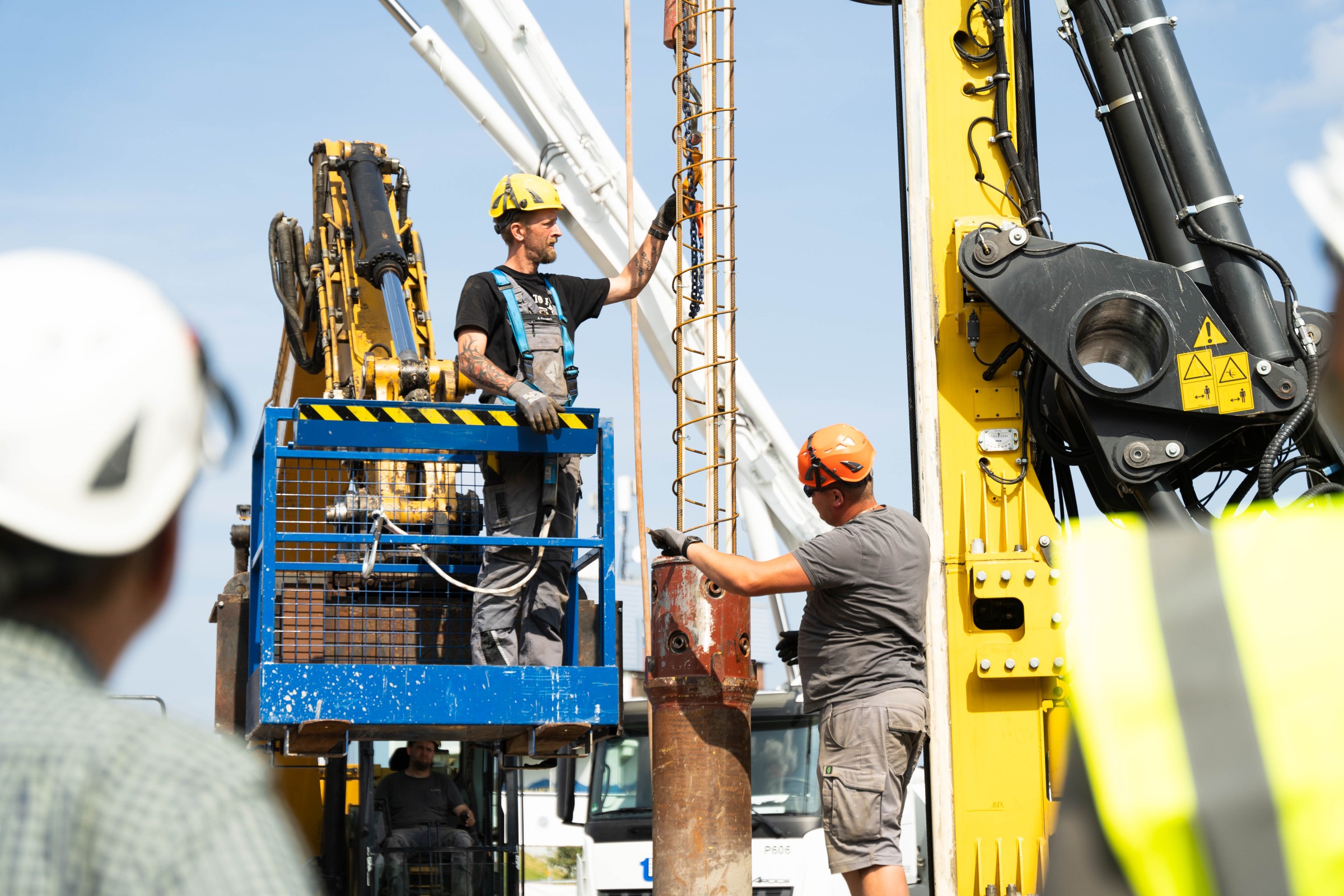
Instead, Thade Gerdes relies on vibration-free displacement bored piles, which remain reliably load-bearing even in confined spaces or on complex ground conditions.
We do not perform pile driving work, but we are well aware of the limitations of this method and would be happy to advise you on more effective alternatives in the field of specialized civil engineering.
Here you can learn more about pile foundations and their applications!
Vibration-Free Displacement Drilled Piles Instead of Pile Driving: Your Benefits with Thade Gerdes
✔ Experience That Makes a Difference
With more than 125 years of experience in specialized civil engineering, we understand the technical requirements of a wide variety of foundation projects and implement them in a practical manner.
✔ Quiet Methods for Sensitive Environments
The drilling techniques we use are vibration-free and low-noise: ideal for projects requiring protection of neighboring areas or meeting specific requirements.
✔ On Land and in Water
Whether inland or along the shoreline: We carry out foundation work on solid ground as well as in aquatic environments safely and in compliance with standards.
✔ Quick Project Kickoff Thanks to Well-Coordinated Processes
From initial planning to equipment delivery, all processes are coordinated so that your construction project can begin without delay.
✔ Predictable Costs with No Surprises
Our quotes are clearly structured. You’ll know right from the start which services are included and what costs to expect.
✔ On-time delivery in every project phase
We coordinate everything precisely, from the construction schedule to the execution. This ensures your project stays on track, even with complex requirements.
✔ Certified Environmental Protection According to DVGW W120-1
We consistently comply with environmental regulations using methods that protect the soil and groundwater.
✔ Dedicated contacts for clear communication
A personal project manager will keep you informed every step of the way and is available to answer any questions you may have at any time.
✔ A Reliable Partner for Public and Private Clients
Whether it’s a municipal contract or a large-scale private project, we deliver reliable results that stand up to the challenges.
Now Request a quote for deep foundation work: Thade Gerdes will assist you with your civil engineering project!
Conclusion: Driven piles, or is a vibration-free method better?
Driven-pile foundations are among the most reliable and rapid foundation methods, provided the conditions are right. They offer their full advantages when the soil is stable at a moderate depth, load requirements are high, and ample space is available. They can be a cost-effective solution, particularly for large-scale foundation projects or time-sensitive construction projects.
However, whenever vibrations must be avoided—for example, due to sensitive existing structures, ongoing production, or confined spaces—other methods are the better choice, such as vibration-free displacement bored piles. They offer similar load-bearing capacity with significantly less potential for disruption to the surrounding area and the construction process.
Would you like to find out which procedure is right for your construction project? Request Request a quote for deep foundation work from Thade Gerdes!
Frequently Asked Questions About Driven Pile Foundations
What is the difference between a driven pile and a bored pile?
Driven piles are driven into the ground as prefabricated elements, while bored piles are drilled, reinforced, and filled with concrete on site. Driven piles are particularly suitable for soils with sufficient bearing capacity or that can be compacted, whereas bored piles are better suited for difficult soil conditions or sensitive environments.
What types of piles are used in driven-pile foundations?
Common types of driven piles include concrete piles, steel piles, wooden piles, displacement piles, and micropiles, depending on the application, soil conditions, and load requirements.
In which soil layers is driven-pile foundation construction possible?
This method works most reliably in compactable soils (e.g., sand layers) or in firmly compacted soil layers capable of supporting heavy loads. A site investigation is a prerequisite for this.
How deep do driven piles need to be driven into the ground?
The depth depends on the soil profile, the required bearing capacity, and the structural loads. Depending on the project, pile lengths range from a few meters to over 20 meters.
How is the load-bearing capacity of driven piles ensured?
The bearing capacity results from frictional resistance and tip pressure. Penetration into layers with sufficient bearing capacity is verified using modern techniques such as pile driving energy measurement and installation logs.
What role does the pile jacket play in load transfer?
The pile jacket transfers loads to the surrounding soil through friction. Especially in soils that can be compacted, jacket friction can account for a significant portion of the bearing capacity.
What is a pile cap, and when is it used?
A pile shoe is a component attached to the tip of a pile that facilitates penetration into hard soil layers. It is used in particularly resistant soil conditions or with steel pipe piles.
What standards apply to driven-pile foundations?
Installation is generally carried out in accordance with DIN EN 12699, which defines the requirements for installation, quality assurance, and documentation.
What materials are used in driven-pile foundations?
Depending on the application, reinforced concrete, solid steel, steel pipes, or wood are used. The choice depends on the structural requirements, soil profile, and surrounding environment.
Can driven piles be used with existing buildings?
Generally not. Due to the vibrations caused by pile driving, its use in existing structures is very limited or not possible at all. In such cases, low-vibration alternatives such as bored piles or micropiles are recommended.
When is a driven-pile foundation not suitable?
In cases of extremely confined spaces, sensitive adjacent structures, or a lack of access for pile driving, this method generally cannot be used. Alternatives, such as bored piles or micropiles, are also required when there is no load-bearing layer in the subsoil.

